




The cancellation of the Constellation class of frigates for the US Navy on November 25, 2025, marked a deep rift between operational needs, the Pentagon’s political choices, and the peculiar bureaucratic culture of NAVSEA (the Naval Shipbuilding Administration), which often views foreign designs more as a threat than an opportunity. The statement by US Navy Secretary John Phelan was brief, ostentatiously austere, but behind it hid a program that stumbled on cost problems, delays, and above all the inability to align a European design with the strict, often excessive, requirements of American specifications.
The cancellation of Constellation does not only affect the at least twenty ships that were to be built. In fact, the US Navy continues to need a similar successor that will be built in much larger numbers. The fleet’s estimated requirement, over a decades-long horizon, foresees over fifty frigates, making the choice of the platform, not an individual procurement, but the shaping of an entire future doctrine.
The need is urgent, in fact, for the US Navy to strengthen its surface forces in the Pacific. Within this context, the Legend class of Huntington Ingalls Industries stands out as one of the most realistic options. Not because it is the most perfect design — it is not — but because it has maturity, known shipbuilding behavior, low risk of systems integration and the ability to be transformed into a decent frigate without requiring a redesign from scratch.
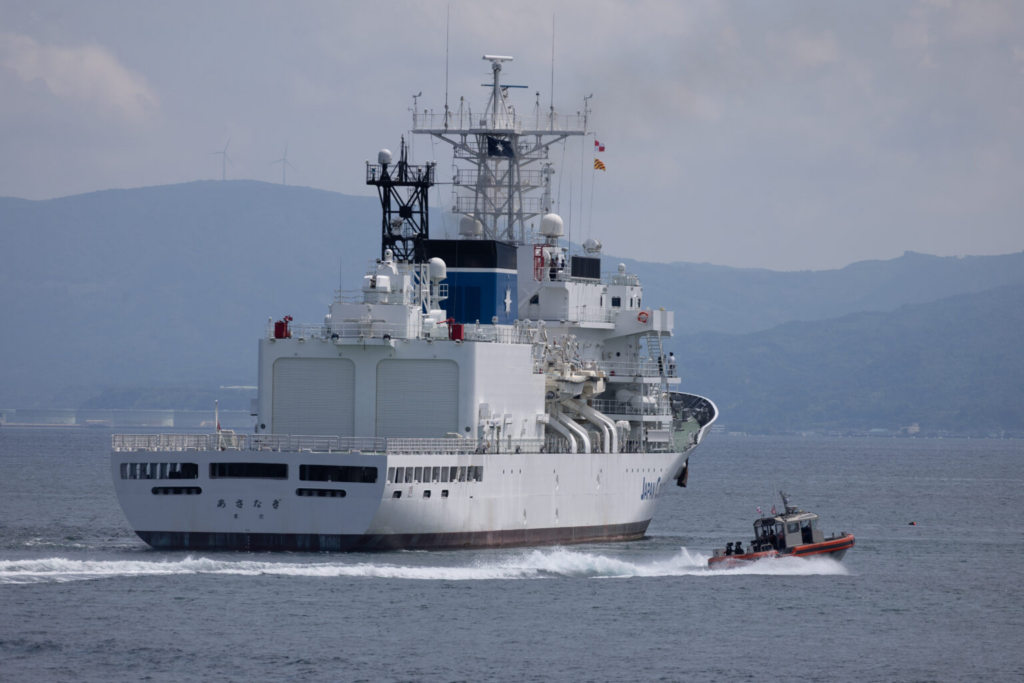
Legend, or Hamilton class since 2019, is the largest and most capable ship ever delivered to the US Coast Guard with 10 vessels in service. At 127 meters long, with a displacement of approximately 4,600 tons and CODAG propulsion combining two MTU diesel engines with an LM2500 gas turbine, it has demonstrated admirable durability in oceanic operational environments. Its 12,000 nautical mile range and rugged design make it a suitable platform for long-range roles. Legend can also be upgraded to Survivability Level II at a relatively low cost, because its basic structure was designed from the beginning with specifications closer to combat units. And its structural strength, bulkhead reinforcement and center of gravity height have been tested in real-world conditions.
One of its main advantages is the stability of the hull under a greater load of armament/equipment. Here, the FREMM, as a European design, with a top acoustic and balanced hydrodynamic footprint, is based on very specific weight parameters. When the US Navy requested that domestic equipment systems, heavier wiring, differentiated compartmentalization, and of course reinforcements for increased survivability be incorporated into the same design, the center of gravity of the vessel, now called Constellation, began to shift significantly.
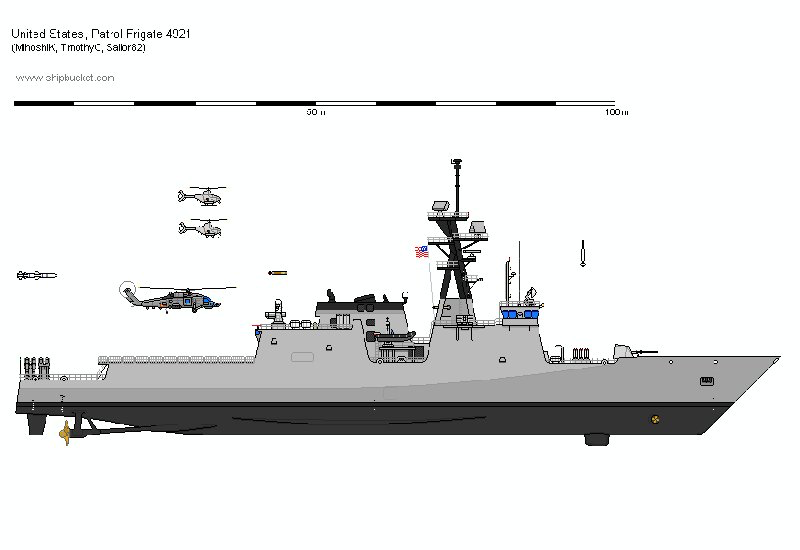
In Legend, the same process is more controlled. The ship has a large available load increase envelope, a high buoyancy margin, and a hull form that allows the addition of several tons without affecting stability. So here, an addition of 32 vertical launch missile cells, type Mk41, with 16 in the bow and 16 further aft, does not require modification of the basic deck cross-sections. The vessel also already carries the 57mm MK110 cannon and a Phalanx for close-in defense as a Coast Guard, while it has a regular helipad and helicopter hangar.
Technically, the most sensitive part of a frigate is not the placement of the vertical launch cells, but the noise management. The FREMM is one of the “quietest” frigates in the world, thanks to the vibration isolation technology with elastic mounts in its engine rooms, the detailed study of the management/production of low frequencies and the careful isolation of the main engines. The Legend does not have the same level of soundproofing technology in its basic version, but it can be upgraded.
Here, perhaps replacing the propeller with a new design, with minimal cavitation, adding rubber mounts to the engine rooms around the engines, and applying shock-absorbing panels can reduce the acoustic footprint to a level sufficient for anti-submarine operations, especially when supported by a towed CAPTAS-4 sonar or the cheaper but purely American TRAPS. While the integration of the AN/SQS-53C hull sonar is feasible due to the existing space.
The FREMM is still, objectively, a better ship in terms of pure anti-submarine performance. But the Legend has an advantage that NAVSEA does not ignore: It knows how it will react to shock tests, because the basic structure has already been tested accordingly. It also knows how it will behave when loaded with heavier sensors, because relevant studies have been conducted for the Patrol Frigate 4921 variant. While the vessel can be supplemented by the integration of a reasonable cost radar such as the TRS-4D.
In addition, Legend has an advantage that, in a multi-decade program, cannot be underestimated, and that is its industrial support. Huntington Ingalls Industries is a 100% American company, the largest of its kind in the country, with production lines that build Arleigh Burke destroyers, amphibious ships, and even nuclear-powered aircraft carriers through its Newport News shipyard.
Legend production is at full maturity as far as the US Coast Guard is concerned. The hull block manufacturing process has been optimized, the workforce is highly skilled, and the rate of boat production from the shipyard can be reduced, with financial support from Congress. This way, this industrial base will not have to radically adapt to new designs and new suppliers.
Beyond the shipbuilding, Legend as a frigate can utilize increased electrical power and cooling capabilities, something that modern designs consider necessary for future energy weapons systems without any tectonic change to the basic architecture of the ship.
Of course, none of the above means that Legend is technically superior to FREMM or that the US Navy chooses the optimal solution. On the contrary, FREMM was a better design, of greater displacement, and as a Constellation could have evolved into an excellent ship, if NAVSEA had shown flexibility, accepting that a European design cannot be transformed into a fully “American ship” without upsetting its balance. The cancellation reflects the technical limit of FREMM, but also the institutional impasse of an agency that wants to control everything, even when this means huge delays or cancellations, at incredible cost to the American taxpayer.
But the crucial question today is not which ship is better. It is which ship, even with compromises, can be built quickly, in large numbers, predictably, and without significant risk. And the US Navy needs to be taking delivery of new ships by 2028–2029, not 2035. It needs frigates that can reach fifty units without causing a collapse or blockage of the industrial base. And it needs a platform that can cover surface, submarine, and land combat roles without requiring a complete redesign.
In this context, the Legend class, evolving into a frigate – is a realistic solution, albeit at a lower level of capabilities. And the US Navy, regardless of its actual technical and operational preferences, is subject to the political and industrial forces that shape its environment. And these forces make an all-American plan an almost inevitable choice.

