



Yesterday, Wednesday, February 19, Russian President Vladimir Putin himself announced that units of the 810th brigade of the Russian armed forces had crossed the Kursk border and were in the Sumy region of northern Ukraine.
The advance towards Sumy took place a few hours after Russian soldiers managed to liberate the village of Sverdlykovo. Starting from this settlement, Russian units advanced towards the village of Novenkoye in the Ukrainian Sumy region.
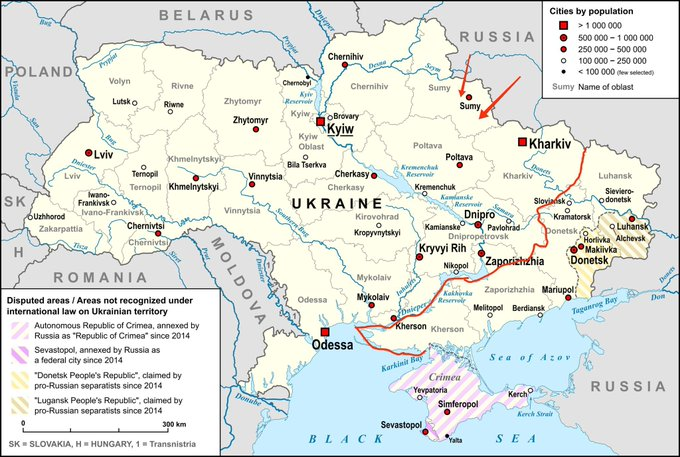
The Russian forces will then advance towards the village of Basovka with the aim of bypassing the well-fortified Ukrainian positions. The ultimate goal of the Russian invasion of Sumy appears to be the destruction of the main supply route that the Ukrainian armed forces use to supply their forces in the Kursk Bulge. This supply route appears to be located in Sumy.
We should inform you that the Russian attack on Sumy is by no means a full-scale invasion, at least not yet. The exact number of Russian soldiers who entered Sumy remains unknown, but it is certainly not large enough to qualify as a “mass invasion.”
The Russians simply want to create a security zone (gray zone) beyond Kursk to protect their region from future Ukrainian attacks.
And as mentioned above, now was the right time for such an operation, because on February 16, the Russian army managed to retake the village of Sverdlikovo in Kursk. Using this settlement as a springboard, soldiers of the 810th Moscow Brigade crossed the border into Ukrainian Sumy.
During the advance towards Sverdlikovo in the previous days, Russian forces are said to have gained control of key settlements located between the city of Sundzha and the town of Risk. This resulted in further complicating the Ukrainians’ logistical operations.

