In the wake of the dangerous escalation recorded in the Ukrainian crisis after the US gave the green light to the use of American weapons for strikes against Russia, Moscow is striking Western Ukraine and especially the Lviv region with unprecedented intensity.
Lviv has a particularly important role for Ukraine and NATO, as it is a major hub for the transfer of military personnel and equipment. The last major attack was recorded on the night of May 31 to June 1, 2024.
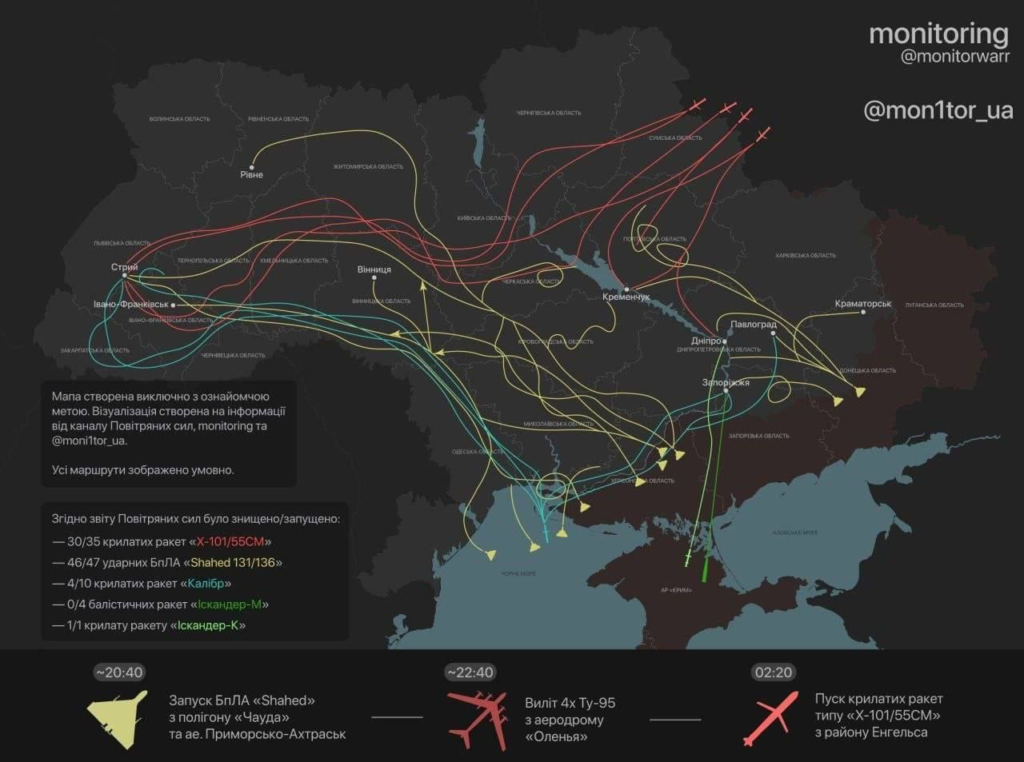
Russian forces struck and destroyed three important facilities in the Lviv region. It is noteworthy that the massive Russian attack lasted almost three hours, from 03:29 to 06:10. Four people were injured in the attack.
Russia reportedly attacked with 47 Shahed kamikaze drones and 53 missiles of various types, including 35 Kh-101/555 cruises, four Iskander-M ballistics, one Iskander-K, 10 Kalibr cruises and three Kh -59/69s.
Ukrainian air defenses claim to have shot down Kh-101/555 missiles, four Kalibr missiles, one Iskander-K missile and 46 drones. In addition to Lviv, power plants were hit in Zaporizhia, Dnipropetrovsk, Donetsk, Kirovohrad and Ivano-Frankivsk regions. Odessa was also in the Russian crosshairs.
The airfield for the F-16s was also hit
Russian forces managed to strike with particular severity at the military airport near the city of Stryi in Lviv. It is the base, which the Ukrainians were preparing for the NATO F-16s and received a storm of four hits. Russian missiles also hit and destroyed the Lviv battalion of the radiotechnical air defense brigade, located near the airport.
The warehouses of the former engineer battalion were also attacked. Information indicates that a particularly strong explosion occurred. Recently Russian troops carried out at least 5 strikes on Starokonstantinov in the Khmelnitsky region, where there is also a military airfield that can be used as a base for F-16s.
The symbolism
Apart from its great strategic importance the strikes in Lviv carry great symbolism. It is about the city, which is located a breath away from the Polish border, i.e. the border that separates Russia from NATO. Thus, in addition to the operational purposes of the Russian strikes, a strong deterrence message is sent to the North Atlantic Alliance, at a time when the collective West almost threatens to drag the entire planet into a devastating Russia-NATO war.
It does not go unnoticed that as part of the escalation, NATO officials are considering imposing a 100-kilometer No-Fly Zone in western Ukraine.
Russia is aware of Western intentions and just a few days ago carried out a hypersonic strike on the Yavoriv training camp, which is notorious for hosting various elite Ukrainian units and foreign mercenaries, as well as NATO personnel.
The Yavoriv strike that shocked NATO
Yavoriv is located west of Lviv and is only 15 kilometers from the Polish border and has been used as an important hub for the transfer of manpower, weapons and equipment to Ukrainian forces. Russian military sources say a large number of NATO personnel were at the Yavoriv facility, as well as at other camps in the area, including Stryi, Dubliany and Drogobych, all in Lviv Oblast.
The exact number of casualties has not yet been released, but sources say at least 300 soldiers have been killed. The strike was carried out by the Russian Aerospace Forces (VKS), which dispatched superfast MiG-31K fighters armed with the now legendary 9-A-7660 “Kinzhal” hypersonic missile systems.
This is not surprising, given that Moscow’s ISR (intelligence, surveillance, reconnaissance) means are always on the lookout for high-priority targets, especially large concentrations of NATO personnel (Americans, Poles, French, etc.). Such strikes demonstrate that a NATO attempt to impose No-Fly Zones in Ukraine is doomed to failure.
The 25 strikes
Russian troops carried out 25 strikes with precision weapons, including hypersonic Kinzhal missiles and drones against Ukrainian military positions during the week in the special military operation in Ukraine, the Russian Defense Ministry said on Friday (31/5/2024), choosing to do not mention by name the sweeping blows in Lviv. More specifically:
“On May 25-31, the Russian Armed Forces carried out 25 combined strikes with precision weapons, including hypersonic Kinzhal missiles and unmanned aerial vehicles, against command posts, infrastructure, military airfields, air defense systems, arsenals, fuel tanks, production and marine laboratories drones and unmanned aerial vehicles,” the Russian Defense Ministry announced.
In addition, the strikes targeted areas of temporary deployment of Ukrainian army units, nationalist formations and foreign mercenaries, the statement added.

Shockingly dangerous situation
Biden greenlighting Ukraine’s use of US weapons to attack Russia puts the planet in a “shockingly” dangerous situation, says former Defense Department analyst and US Air Force colonel Karen Kwiatkowski.
Biden wittingly or unwittingly brings the danger of a global nuclear conflict much, much closer after listening to “neocon advisers who really have no idea about nuclear dangers, Kwiatkowski told Sputnik.
“The big problem is that Kiev’s drones have already attacked Russian early warning systems designed as part of their nuclear defenses. I don’t think they destroyed them, but that has been done.
If American weapons, heavier weapons are used against these targets, this can only be seen by Russia as a precursor to a first strike – a nuclear first strike. When you hit someone’s nuclear defense radars, their eyes, their defense systems, then in normal war strategy you should expect a response, said the former Pentagon analyst.
Biden likely feels trapped, looking to get out of the Ukraine quagmire and push the conflict “out of the public eye” but will make the situation “much worse” by expanding the geography of the conflict, Kwiatkowski believes.