



The US Treasury Department is joining forces with Japan to confront investors betting against the yen: but who really holds the stronger bargaining chips — Washington or Tokyo?
At the same time, it seems that the dollar system under Trump has become toxic and threatens the US’s closest and most stable ally, having been driven to excessive debt to support it.
Trump presents the first joint US-Japan currency intervention since 2011 as a “message of friendship,” a move that, he argues, will strengthen economies internationally. And indeed, violent fluctuations in the yen can prove extremely destabilizing.
Few financial mechanisms act as a more powerful accelerator of instability than the so-called “yen carry trade,” a strategy that has led to the collapse of numerous hedge funds.
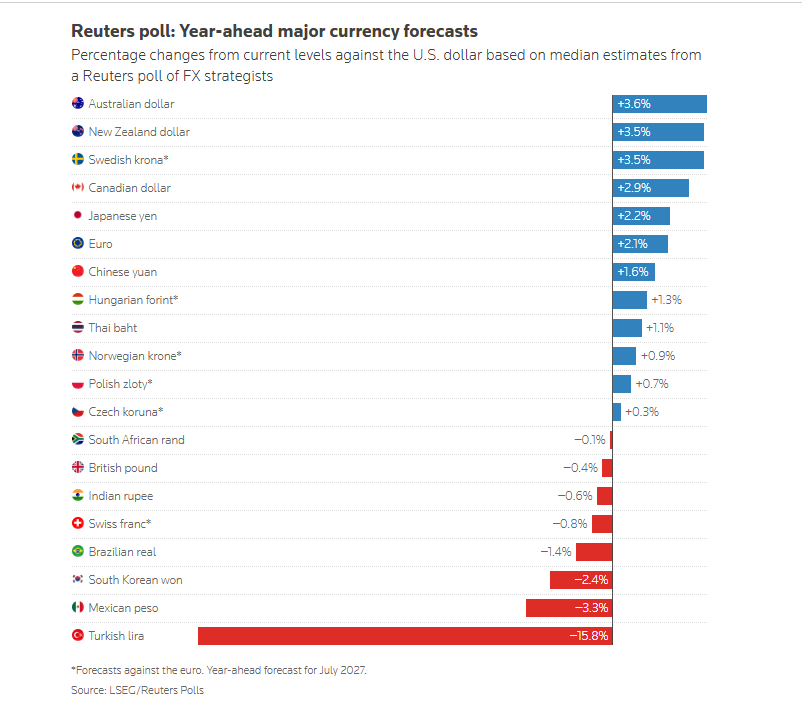
Two decades of near-zero interest rates have turned Japan into the world’s largest creditor nation. Investors have borrowed cheaply in yen to seek higher returns abroad, pushing up valuations of Argentine bonds, South African commodities, Indian real estate, the New Zealand dollar, derivatives on the New York Stock Exchange, and even cryptocurrencies.
When the yen rebounds sharply, those trades are cleared at lightning speed. Markets move one way when the yen moves the other.
Japan is the largest foreign holder of U.S. Treasuries, with a portfolio of nearly $1.2 trillion. This exposure works both ways.
It is a huge responsibility to have so much of the nation’s wealth tied up in a currency whose value is threatened by Trump’s policies — including his efforts to bring the Federal Reserve under greater political control.
At the same time, however, Tokyo is well aware of the influence that comes with its position as America’s largest financier.
Something big is happening…
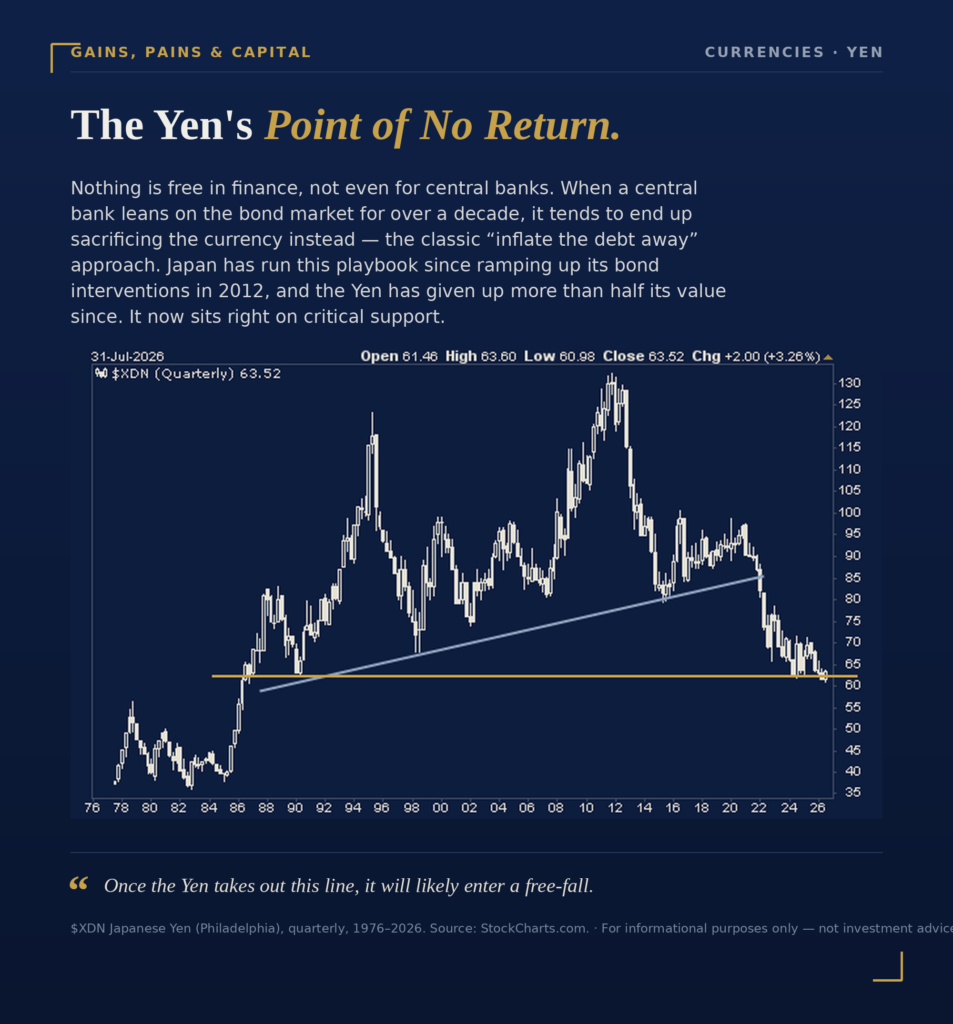
Scott Bessent’s team has about $1.2 trillion to keep the yen’s volatility in check. After more than 30 years of monetary intervention, the Japanese yen is on the verge of a free fall.
Last week, the yen came dangerously close to breaking down a critical technical support level. A break below that level would pave the way for a full-blown collapse, sending the currency to levels not seen since 1990.
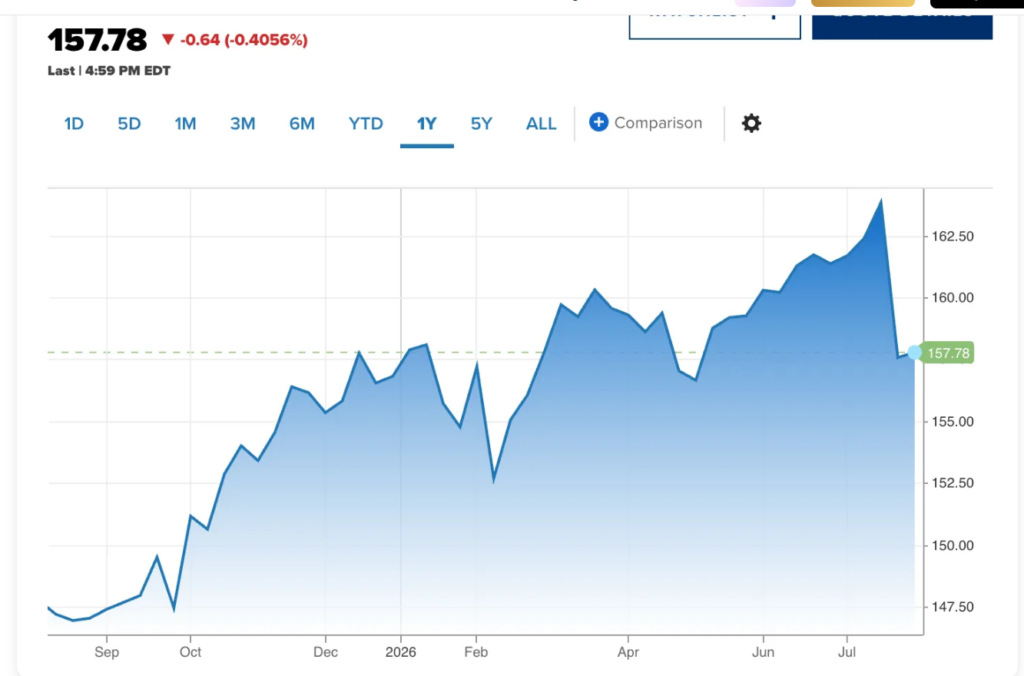
Japan is doing everything it can to prevent such a scenario, resorting to ever-greater intervention in the currency markets. The problem, however, is that in order for the Bank of Japan (BoJ) to buy yen, it must liquidate assets to provide the necessary liquidity. And the assets Japan is liquidating are U.S. Treasuries.
To be clear, these are not small amounts. In one day alone, the BoJ spent a record $52 billion in a single day.
It is clear that the United States does not want to see the largest foreign holder of U.S. Treasuries go on a massive sell-off.
That is why last week the U.S. Treasury intervened actively in favor of the yen for the first time since the 1998 Asian Financial Crisis.
Mutually assured destruction
The timing could hardly be worse. Traders call this scenario “mutually assured destruction”: a massive sell-off would hit Japanese exporters hard and send interest rates soaring worldwide.
It also remains highly uncertain whether the first joint US-Japan intervention in 15 years will prove effective.
One reason is that both the Japanese and American sides seem to be acting more for show than with any real intention of steering markets.
A typical example is the fact that the US sold euros to buy yen, rather than using dollars.
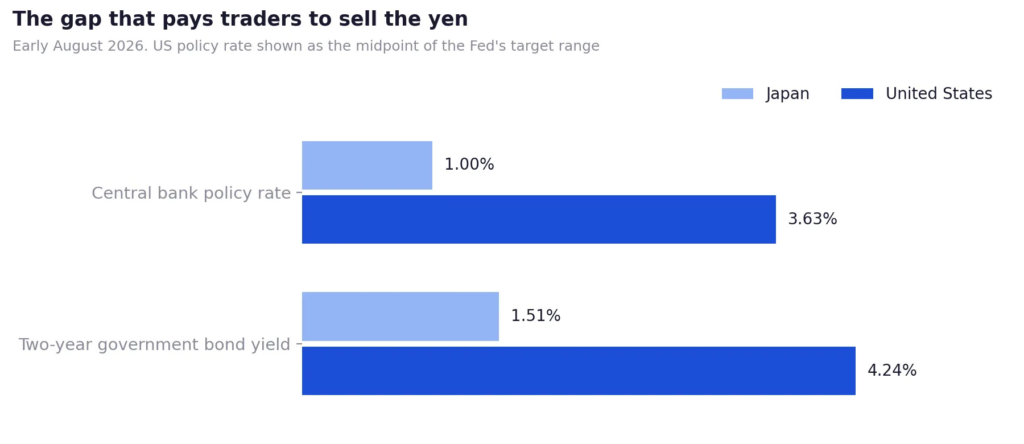
And it is clear that unless the Bank of Japan finds the courage to raise interest rates above the current 1%, those betting on further yen weakness have every reason to question Tokyo’s determination to strengthen the currency.
Japan’s patience is running out…
It’s one thing for the US and Japan to call the yen “substantially undervalued” and quite another for central banks to take the necessary steps to support it, says Thanos Chonthrogiannis, chief economist at Trust Economics.
Nevertheless, Sanae Takaichi’s patience with Trump appears to be running out. Late last month, Trump imposed new tariffs of 10% to 12.5% on 60 trading partners, including Japan, which is supposedly a “friendly” country. Tokyo was caught off guard.
Sanae Takaichi’s government is working in good faith to put together the $550 billion package that Donald Trump demanded in exchange for tariff reductions. Japan is coordinating with JPMorgan and other US banks to structure the financing.
However, domestic banks appear cautious, as their funding base is in yen, which makes it expensive to raise large sums in dollars to finance long-term infrastructure projects.
The Liberal Democratic Party (LDP) has every reason to feel that it is not receiving the recognition it deserves from an American president who is rapidly alienating his allies.
In the vortex of geopolitical developments
At the same time, Japan is right at the center of Trump’s high-risk geopolitical initiatives. The country imports 95 percent of its oil from the Middle East, making it particularly vulnerable to both the conflict that is currently pushing up global energy prices and any rise in U.S. Treasury yields.
The White House should be aware that another collapse like that of Long-Term Capital Management (LTCM) could prove catastrophic. LTCM’s 1998 collapse was triggered in part by a sharp rise in U.S. Treasury yields and was one of the most severe financial crises before 2008.
A repeat of such an episode — which could be triggered by tariffs, inflation, or a clash with China — could make even the Lehman Brothers crisis of 2008 look like a mild financial crisis.
Today, with the US national debt approaching record levels, inflation remaining high, and population growth slowing, Asia has good reason to be concerned about the US fiscal situation.
Trump’s Republican Party has abandoned any pretense of fiscal discipline. The political deadlock in Congress is even deeper than in 2011, when S&P stripped the US of its top AAA credit rating, effectively confirming warnings then by Chinese Premier Wen Jiabao about the need to protect China’s vast dollar reserves.
At that time, the US national debt was less than $12 trillion, less than half its current level. Beijing eventually concluded that, in the event of a financial crisis, the United States had more to lose than China.
Japan has made similar calculations in the past. In 1997, then-Prime Minister Ryutaro Hashimoto admitted to a New York audience that Tokyo had “several times” considered dumping US Treasuries to send a political message, even during intense negotiations over the auto industry.
Sanae Takaichi’s Finance Ministry is also on high alert. A volume of Japanese state wealth equivalent to the annual GDP of Switzerland is invested in US government debt.
At the same time, Trump’s policy mix—inflationary tariffs, encroachments on the independence of the Federal Reserve, a weakening of the Internal Revenue Service (IRS), and the pursuit of trillions of dollars in new tax cuts—is based on the assumption that Asian central banks from Tokyo to New Delhi will continue to be willing to finance Washington’s ambitions. That assumption is looking increasingly uncertain.
Asia is watching and preparing to respond
The irony is obvious. A quarter of a century ago, Washington lectured Asia on crony capitalism, institutional opacity, and unaccountable governance.
Today, Asia is watching with bewilderment as the United States undermines its own financial credibility with astonishing speed.
Policymakers across the region are considering various scenarios for how Trump’s tariffs and erratic economic policy could upend their economies. For now, the damage Trump has done to equity markets may be less than the blow he has inflicted on bond markets.
Under normal circumstances, recession risks would favor bond markets, but the inflation caused by the tariffs has overturned that logic.
Markets are concerned that the Trump administration appears to be more tolerant of a recession or even extreme global economic turmoil than many had thought possible.
Over the past year, the turmoil in bond markets has repeatedly forced the Trump team to back down.
There is also the view that part of Scott Bessent’s drive to stabilize the yen is aimed at preventing a similar move by China.
This dynamic is reminiscent of the late 1990s, when global markets were deeply concerned that China would devalue the yuan. Such a development would trigger a new race of competitive devaluations in international currency markets.
Currency War
After all, if one were Chinese President Xi Jinping and faced with mounting trade headwinds, why wouldn’t one opt for a more favorable exchange rate? Especially when the “beggar-thy-neighbor” policies of U.S. ally Japan provide him with political cover.
Such a development could lead to a currency war on a scale that markets have probably never seen before. When two of the world’s largest economies jointly intervene in markets for the first time in more than a decade, it essentially tells investors that there are pressures building beneath the surface of the global financial system, not just a problem with an exchange rate.”
The real question is when the most powerful bond vigilantes — that is, the central banks themselves — will start actively selling US government bonds.
Japan and China are Washington’s biggest lenders, followed by the United Kingdom, Luxembourg, the Cayman Islands, Belgium, Canada, France, Ireland, Switzerland, Taiwan and Hong Kong.
If markets perceive that any of these countries are selling US bonds — or even simply suspending their purchases — global credit markets could be thrown into chaos.
If Trump understands this danger, he has so far failed to show it to the Asian central bankers who, in effect, hold control of the US economy in their hands. As 2026 unfolds, the initiative for action may be more in Japan’s hands than Trump’s team believes.
The multi-trillion dollar question
The multi-trillion dollar question — as trillions of dollars in assets are valued based on the yen and Japanese government bond yields — is this: Was this intervention enough to de-escalate market tensions?
The answer appears to be a resounding “no.”
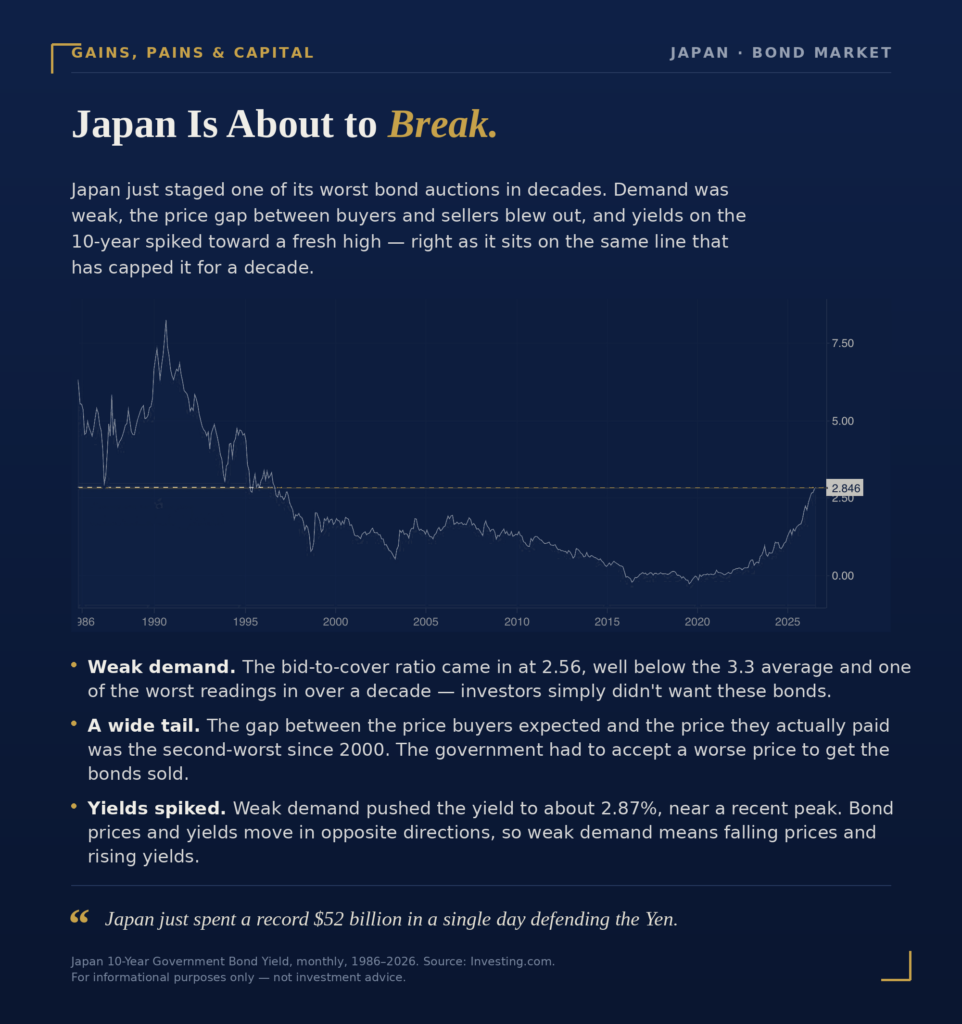
Japan held one of the worst government bond auctions in decades. Without going into the technical details — as bond auctions are extremely complex — here’s what happened:
- Weak demand: The bid-to-cover ratio (which measures how many bids were submitted relative to the number of bonds available) stood at 2.56, significantly below the usual average of 3.3, recording one of the worst performances in the last decade. This suggests that investors showed limited interest in these bonds.
- Large “tail”: The difference between the price investors expected to pay and the final price at which the bonds were issued was the second largest since 2000. Simply put, the government was forced to accept a lower price (and therefore higher borrowing costs) than it had expected in order to complete the issue.
- Yields soar: Weak demand has pushed the yield (i.e. interest rate) on these bonds to around 2.87%, nearing recent highs.
Bond prices and yields move inversely; weak demand means falling prices and, by extension, rising yields.
The yield on the all-important 10-year Japanese government bond is now on a near-vertical upward trajectory. The final stage of Japan’s massive public debt “bubble” appears to be approaching.
The Great Debt Crisis is Just Around the Corner
Japan is the most prominent example of excessive borrowing and extreme central bank intervention.
The United States reached a debt-to-GDP ratio of 100% for the first time in 2015.
Japan had already reached this level in 2001.
The United States first introduced the Zero Interest Rate Policy (ZIRP) and Quantitative Easing (QE) in 2008 to address its debt problems.
Japan had implemented the same policies since 1999 and 2001, respectively.
Since then, Japan’s central bank, the Bank of Japan (BoJ), has effectively nationalized the country’s entire financial system. Today, the BoJ:
- Holds more than 50% of Japan’s public debt.
- Is the largest shareholder in Japanese listed companies worldwide.
- Is among the top ten shareholders in more than 90% of the companies in the Nikkei 225 index.
- Has a balance sheet larger than Japan’s Gross Domestic Product (GDP).
All of these interventions have allowed Japan to accumulate a level of public debt that exceeds anything ever recorded. The public debt-to-GDP ratio stands at 215%.
Interest payments on debt service constitute the second largest category of government budget expenditure — after social security spending — absorbing about 24% of the country’s federal budget spending.
Simply put, as worrying as the situation in the United States may seem in terms of public debt and monetary interventions, the situation in Japan is many times more intense.
And, based on current data, Japan has a serious possibility of being the first country to enter a public debt crisis. In financial markets, nothing is free. Not even for central banks.
When a central bank constantly intervenes in the bond market, it usually ends up sacrificing the value of the national currency, following the well-known strategy of “inflating the debt away”.
Since the Bank of Japan stepped up its interventions in the government bond market in 2012, the Japanese yen has lost more than 50% of its value.
And, as of this writing, the yen is sitting right on top of a critical technical support level. If it breaks below that level, it is very likely to enter a freefall phase.

