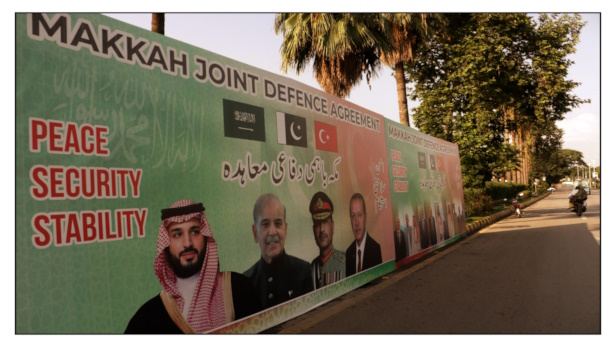

Turkey, Saudi Arabia and Pakistan signed a trilateral defence pact on August 7 that nominally incorporates three of the most important military and economic states in the Muslim world into a mutual defence agreement, but the details of the agreement were not made public.
The agreement, signed in the holy city of Mecca by Turkish President Erdogan, Saudi Crown Prince bin Salman and Pakistani Prime Minister Sharif, reportedly stipulates that an armed attack on one of the three states is considered an attack on all. In identical statements, the three governments described the agreement as a measure to strengthen collective deterrence against any aggression and to deepen defence cooperation overall.
Yet the pact’s name reflects a certain ambiguity in its self-image: Statements from Pakistan and Turkey referred to it as the “Mecca Joint Defence Agreement,” while some state media outlets reported it as a “Mecca Joint Deterrence Agreement.” The difference is more than semantic; it suggests that there is no clear red line, with the signatories maneuvering between a hard mutual defense commitment and a looser deterrence framework.
It should be noted that Saudi Arabia and Pakistan had previously signed a bilateral mutual defense pact, the “Strategic Mutual Defence Agreement,” on September 17, 2025, during the state visit of Pakistani Prime Minister Sharif to Riyadh. Like the Mecca Agreement, this also contained the promise of Saudi Arabia and Pakistan that any aggression against either state would be considered an attack on both, recalling that it had been signed in the wake of the Israeli attack on Doha, Qatar on September 9, 2025.
However, when the Houthis recently attacked Saudi oil tankers and the Saudi Aramco oil refinery in Jizan, Pakistan did not react. Under the terms of the Saudi-Pakistani agreement, the two countries would have to respond to the Houthi attack jointly.
So what is the potential threat that the Mecca Agreement is supposed to deter? Officially, the pact does not name anyone. In practice, its subject matter is widely read. All three governments have expressed concern about Israel’s expanding military footprint in Gaza, Lebanon and Syria, while Erdogan has repeatedly accused the Israeli government of trying to “dynamite” the US-Iran Memorandum of Understanding signed in June to halt hostilities.
The Israeli government has not yet commented publicly on the deal. Iran’s reaction has been mixed. An Iranian lawmaker dismissed the deal on social media, arguing that a deal with Turkey and Pakistan would not bring the Saudis more security than their dependence on Washington. Iran’s Foreign Minister Araghchi, on the other hand, reacted positively to the Turkey-Saudi Arabia-Pakistan alliance, stating: “Iran’s powerful armed forces have demonstrated their willingness, capability and strength against the most expensive army in the world. When Muslims stand united, we can immediately confront any challenge from evil foreigners. It is time to rely only on ourselves and live true brotherhood.”
Some Israeli and American commentators have characterized the deepening security ties among the Sunni states as the formation of an anti-Israel bloc. The signatories reject this framework and instead present the pact as a defensive fence in a neighborhood in which the three represent a combined force that is leading the region toward a different security architecture than that which has existed in recent decades, especially in the wake of the Iran war.
It is possible that the Mecca agreement marks the first step in what Putin and Chinese Foreign Minister Wang Yi announced after their meetings with Iran’s Araghchi on April 27 and May 6, respectively. Following his meeting with Iranian Foreign Minister Araghchi, Putin called for a new security architecture in the Persian Gulf and the Middle East.
In agreement with Putin, Wang Yi said after his meeting with Aragchi that Gulf and Middle Eastern countries must “take their future into their own hands” and expressed China’s support for “the establishment of a regional peace and security framework under the leadership of regional countries.” He linked this to the restoration of stability, including safe passage through the Strait of Hormuz, and emphasized regional ownership rather than external domination.
We should not ignore the symbolism of signing this agreement in Mecca. If this were just a normal diplomatic agreement focused solely on security issues, the signing ceremony could have taken place in Riyadh. By choosing Mecca, Turkey, Saudi Arabia and Pakistan sent an unmistakable message, namely that it is a statement linked to the defense of Muslims, not just their respective countries.
It is also noteworthy that this agreement has been in the works for some time, it was not planned in recent weeks. Previously, Saudi Arabia and Pakistan had not condemned the US-Israeli attack on Iran nor had they done anything concrete to support the Palestinians facing Israel’s murderous attack, with the exception of Ankara, which has repeatedly resorted to harsh language against Tel Aviv. Turkey’s participation in the Mecca agreement shows that they have changed their minds and are now taking the first steps towards affirming Islamic hegemony in West Asia.