
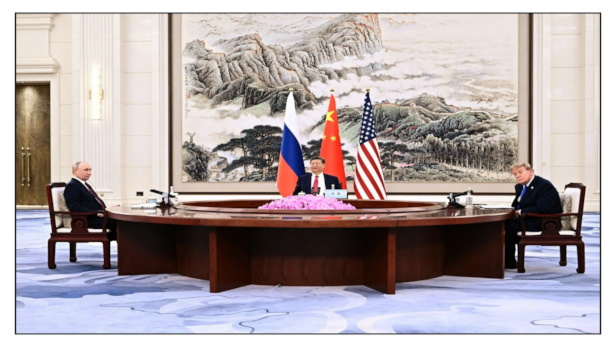
Shenzhen, in Southern China, is the place where the Westphalian world is dying. On November 19, 2026, Trump, Putin, and Xi met there—on the sidelines of the Asia-Pacific Economic Cooperation (APEC) forum—for an unprecedented summit. Tariffs, artificial intelligence, nuclear weapons, Ukraine, Iran, and strategic stability… all loomed over the table.
Three men, three undeclared “empires,” three distinct civilizations—each powerful enough to reshape the planet. The paper-thin “United Nations” may keep its flags; smaller states may keep their anthems. Sovereignty is no longer something securely enshrined in a constitution.
It belongs to those capable of defending it. In reality, only four “civilizational states”—nations that claim to be more than mere nation-states or administrative entities, asserting instead that they constitute entire, distinct civilizations in their own right—truly exist: the United States, Russia, China, and India. Washington, Moscow, and Beijing are the three giants. Everyone else is negotiating the terms of their own insignificance.
The trilateral meeting has been likened to the 1945 Yalta Conference, when the leaders of the US, Britain, and the Soviet Union—at the time—laid the foundations for Soviet dominance in a conquered—or rather, “liberated”—Eastern Europe, and drew the lines that would later define the front of the Cold War.
Now, the People’s Republic of China has the opportunity to emerge as an indisputable player in global affairs. Trump seeks to make his supporters forget their side’s defeat in the US midterm elections by securing diplomatic gains.
President Putin has the chance to project an image of a Russia that is being welcomed back into the ranks of the great powers, despite the devastating economic sanctions imposed by the West.
The world belongs to those who lead. Darwin never promised equality. Nature itself produces predators, survivors, parasites, and fossils. Geopolitics is as ruthless as biology. A nation-state that depends on foreign armies, foreign technology, and foreign money is merely a sovereign fiction.
Its independence ends where the patience of its patron ends. Civilizational states possess something deeper: historical memory, continental space, military power, and the will to dominate. They project their values, institutions, and way of life as a unified civilizational system—often in contrast to the Western model of the nation-state.
Islam is a civilization without a single dominant state. South America possesses a cultural identity but lacks political unity. Brazil dreams of leadership, while the continent remains fragmented.
India embodies the essence of a civilizational state, yet it has not yet attained the global strategic power of the other three. History does not reward those who wallow in nostalgia for past greatness while lacking the strength to reclaim it. It rewards organized power. Might is what counts! Everything else is mere decoration on the walls of victorious empires.
A New Yalta would divide the world into spheres of influence. America retains the Western Hemisphere; the Monroe Doctrine endures because imperial interests endure. Russia maintains its historical sphere across Eurasia.
China is consolidating its strategic primacy in East Asia and the Western Pacific. Moscow views NATO’s advance toward its borders as a clear encroachment upon its historical security space. Beijing rejects American military supremacy on its own doorstep.
Washington demands privileges in the Americas that it denies to its adversaries elsewhere. Hypocrisy has always been—and remains—the native language of empires.
Nevertheless, an arrangement among these three powers could set limits on their rivalry. They would recognize one another’s strategic domains and negotiate the boundaries of intervention. Smaller nation-states would… protest. Naturally, their impotent protests would not alter the balance of power.
Europe is the next… Mongolia. Once the center of empires, armies, and global conquests, it is now transforming into a picturesque collection of historical monuments, governed by timid administrators.
Mongolia once subjugated a vast portion of Eurasia. Today, it survives as a nominally independent country, yet the world barely registers its existence. Europe is heading toward the same historical obscurity and insignificance.
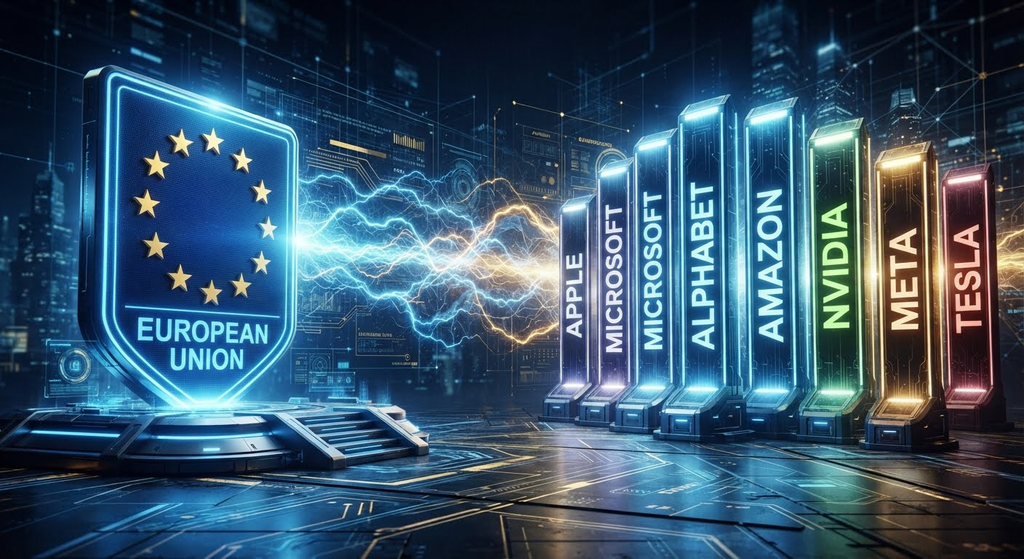
Brussels churns out regulations, Washington provides protection, and European leaders mistake obedience for solidarity. The European Union has become an engine for managing its own decline!
Shenzhen is not yet a “New Yalta.” No agreement has been reached, and the three powers remain rivals. Yet, the logic of the coming era is already visible.
Russia has withstood immense pressure, refusing to abandon its claim to an independent Eurasian order. China has grown powerful enough to challenge American hegemony. America remains formidable enough to defend its imperial position.
India looks on as a fourth civilizational state, one that is still gathering its strength. The “nation-state”—a product of the Treaty of Westphalia—is becoming a historical relic. The three giants will divide the world map.

