
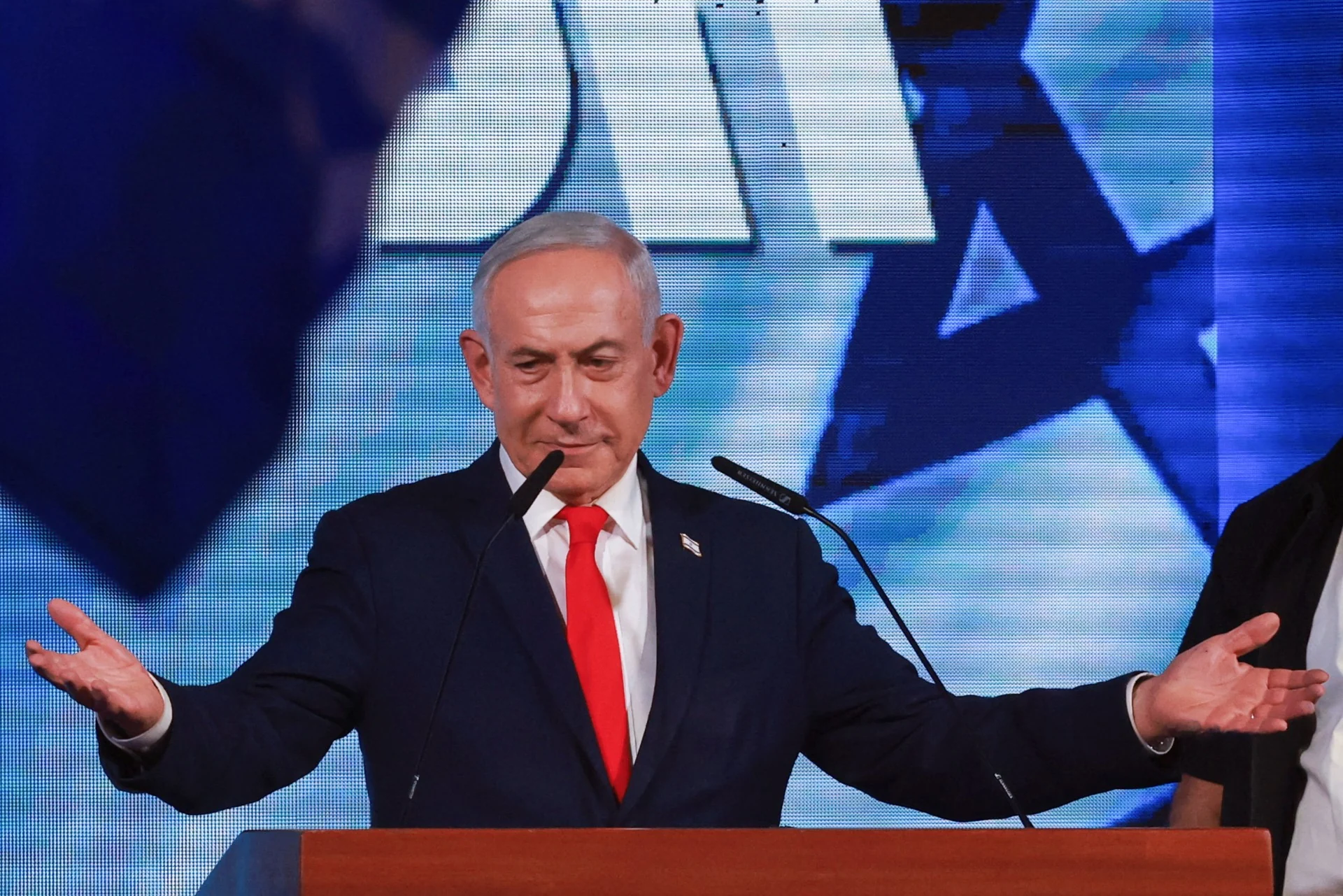
Benjamin Netanyahu did not need a decisive victory in these elections to prevent his opponents from celebrating; it was enough for him to deny them the ability to govern.
This is the paradox of the Israeli ballot box. His coalition has lost its parliamentary majority, yet Likud remains the leading party. And he himself—three years after the greatest security failure in Israel’s history—remains at the center of every calculation regarding what comes next.
With 90% of the votes counted, his bloc appears to have secured 53 of the 120 seats in the Knesset, compared to 48 for the opposition, led by former Chief of the General Staff Gadi Eizenkot. The two Arab parties hold the remaining 19 seats. Neither of the two main factions has reached the 61 seats required for a majority. The vote count is still ongoing.
Netanyahu’s electoral decline is real. However, his removal from power remains an unresolved political question. If his opponents do not agree on a viable governing solution, he remains at the head of the outgoing government, retaining time, the initiative, and room for negotiation.
From Responsibility for the Catastrophe to the Promise of Protection
Following the terrorist attack by Hamas on October 7, 2023, the question seemed to be: when would Benjamin Netanyahu’s political career come to an end?
The leader who had built his preeminence on the promise of security now faced its total collapse. The attack—resulting in approximately 1,200 deaths and the taking of numerous hostages—struck at the very core of his political identity: the conviction that he, better than anyone else, could foresee threats and safeguard the nation.
His response was to shift the focus of public discourse—moving the conversation from how the catastrophe occurred to who could prevent the next one.
Military operations in Gaza, Lebanon, and against Iran allowed him to present a new iteration of his long-standing promise. He asked voters to judge him as the leader capable of bringing the confrontation with Israel’s enemies to a conclusion.
His campaign linked these military successes to a request for another term in office, in order to “finish the job.” At the same time, he attributed blame to the security services regarding the information provided to him prior to the attack—claims that the relevant authorities have rejected.
The political function of this strategy is critical. As long as the threat is framed as an unresolved confrontation, a change in leadership may appear to pose an additional risk. Thus, the demand for accountability competes with the fear of what tomorrow may bring.
Polarization as a Survival Mechanism
Netanyahu’s staying power cannot be explained solely by his choices in the realm of security. It is also explained by the relationship he has cultivated with his electoral base.
For a hard core of supporters, “Bibi” represents a political identity: he embodies distrust of the elites, antagonism toward the center-left, and the conviction that the Right is under constant assault by institutions and adversaries who challenge its legitimacy.
Within this dynamic, his rejection by the “other side” can actually strengthen the rallying of support around him. Criticisms regarding his performance are filtered through the lens of a deeper conflict over who has the right to represent Israel.
This does not mean that his voters have given him a blank check; the loss of his majority reveals the limits of his strategy. It does mean, however, that his erosion in standing does not automatically translate into trust for his opponents.
The opposition needed to convince a sufficient number of these voters that a change in leadership would offer greater security and stability. Condemning Netanyahu—no matter how vehemently—was not enough.
A Numerical Advantage That Becomes a Political Deadlock
The most revealing aspect concerns the possibility of forming a government. Based on the provisional seat distribution, the 48 seats held by the Eisenkot bloc and the 19 seats held by the Arab parties add up to a total of 67. Consequently, the parliamentary arithmetic exists to oust Netanyahu.
However, the corresponding political agreement is not yet in place
Segments of the Jewish opposition have ruled out cooperation with Arab parties. Netanyahu has capitalized precisely on this contradiction, framing such an alliance as a threat to the character and security of the state.
Thus, his opponents are forced to choose between two commitments that are difficult to reconcile: removing him from power and avoiding reliance on Arab political forces. The strong performance of the latter makes this dilemma even more acute.
Herein lies one of Netanyahu’s greatest advantages. The exclusionary stance he promotes limits the governing options available to his opponents—even when he himself lacks a majority.
The votes cast against him outnumber the parliamentary strength of his own coalition. However, in order to achieve a governing outcome, they require a form of cooperation that a segment of the opposition has already delegitimized.
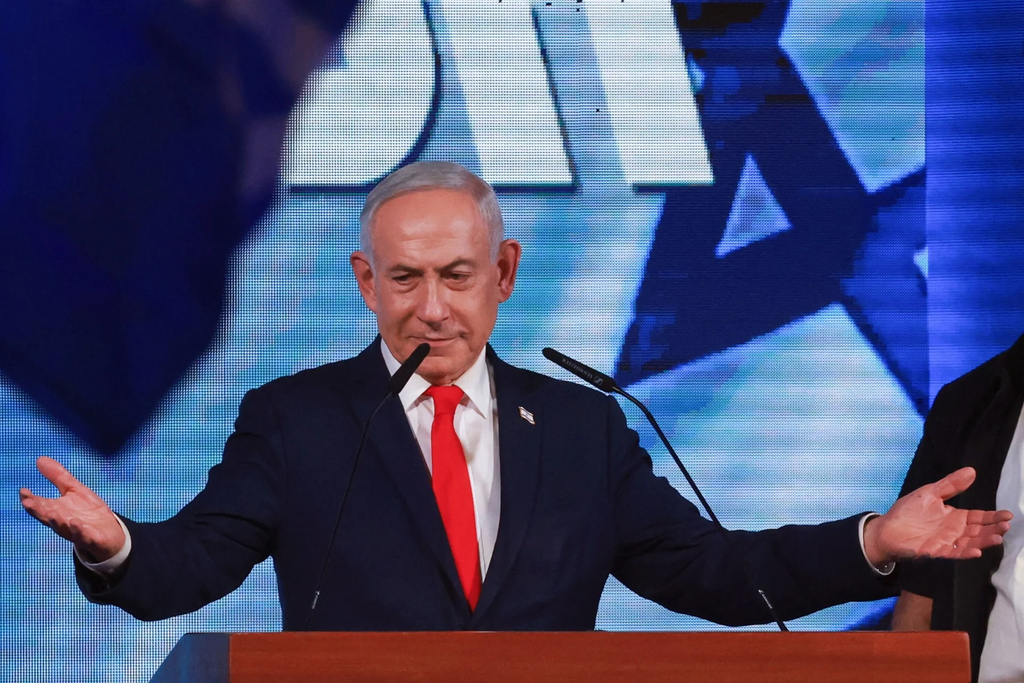
Why did the goal of “getting rid of Bibi” fail to evolve into a coherent plan for governance?
The opposition brings together forces ranging from the center-left to the hard Right. While their shared objective is potent, it does not resolve their underlying disagreements regarding the composition, leadership, and priorities of a potential future government.
The election campaign failed to achieve full consolidation around Eizenkot, nor did it produce a unified, clearly defined political platform. Netanyahu, by contrast, offered a more cohesive message: security, the Iran issue, and the prevention of a government dependent on Arab parties.
This asymmetry is fundamental. Netanyahu sought to continue a specific course, whereas his opponents were tasked with explaining how they would govern together once he was removed from power.
Even the selection of a former military chief of staff was not enough to automatically neutralize Netanyahu’s advantage on security matters. While a rival’s military background is certainly an asset, it must be translated into a compelling political vision to win over voters—voters who, for decades, have seen their own fears and aspirations reflected in Netanyahu.
Time works in favor of the one who remains
From this point on, various paths open up: an agreement among the opposition with Arab support, Netanyahu drawing in other political forces, a broader governing compromise, or a return to the polls.
None of these options is easy. None yet offers any certainty as to who the next prime minister will be.
Netanyahu, however, possesses a practical advantage: he is already in power. As the deadlock drags on, his opponents must prove they can overcome their differences, while he is free to negotiate with those who fear the political cost of fresh elections.
His personal relationship with Donald Trump—who supported him during the campaign—adds another dimension to the argument for continuity. While this is not enough to bridge his parliamentary deficit, it does help him present himself as a leader with access and influence during a critical period for Israel.
The election results do not validate his claim of a clear, decisive victory. Instead, they reveal a more complex and politically resilient reality: Netanyahu may be losing support, yet his opponents have not gained the ability to succeed him. The real test in the aftermath will be whether they can manage to form a majority—one that, for now, exists only as a mere sum of parts. Until that happens, the man who entered the election bearing the burden of October 7th still holds the most significant advantage of his political career: his opponents need an agreement to oust him, whereas he simply needs them to fail in reaching one.

