

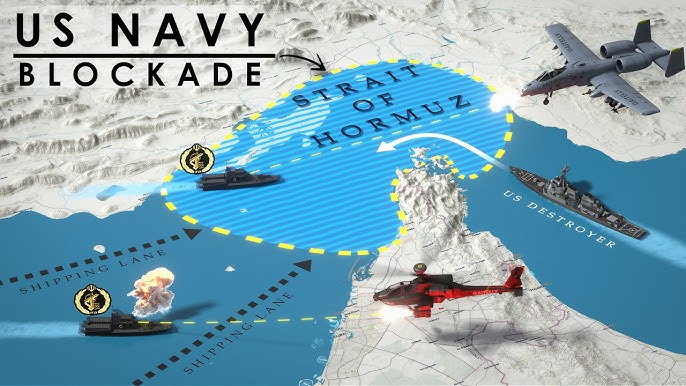
Iran has found that closing the Straits is a much more powerful weapon than the nuclear weapons it is trying to build. Of course, the rest of the world has understood the same.
Ultimately, then, whoever has the ability to close a trade route, especially an energy route, has a very powerful weapon.
Many studies will be written about the closure of the Straits of Hormuz in the future – the issue is already preoccupying all governments in the world and at an institutional level.
If we try to look at the data (which also explain why Iran does not have the right to close the Straits) we have the following in the International Law of the Sea: in man-made sea routes, such as the Suez or Panama Canals, the countries to which these canals belong have the right to exploit them economically, e.g. to charge fees to ships that pass through.
In natural sea lanes, such as the Strait of Hormuz or the Bosphorus, no one has the right to charge fees or close them. They are open and free to all. This is also the reason why Erdogan wants to build a new navigation channel in Istanbul parallel to the Bosphorus Strait, to charge ships that pass through.
So Iran has no right to close an international free maritime passage. Of course, in times of war, these are fine print. Iran closed the passage, so all the oil and natural gas, as well as all the other valuable cargo that is produced, loaded and transported by the countries of the region, are suddenly removed from international trade. This causes a huge energy crisis for everyone, both in the countries that consume these products and in the countries that produce them and cannot sell them.
The bottom line is that controlling an energy route, but also any trade route, is today the most powerful weapon, even than missiles, because its impact is global and not local. For history, this is not a new finding, if one considers that the Portuguese and Spanish navigators made the explorations and discoveries of the New Worlds because the Mediterranean and Middle Eastern route through which goods passed to and from Asia had been controlled by the Venetians and the Ottomans respectively, therefore they had to bypass this centuries-old traditional trade route (the Silk Road).
The question now is how this story will end, whether the governments of all countries will accept to pay Iran for passage, whether the production of the Gulf countries will resume and when it will reach the levels it was before the war, since the infrastructure damage is already enormous, and how the region will calm down, which is currently in an explosive state. The equation is very difficult, with many parameters, different mindsets and unimaginable pain from the thousands of victims.
The second issue is how the world community will handle such situations in the future, since the international sea passages that are free today may tomorrow be closed by anyone who has the ability to do so. For example, for anyone who doesn’t bother to look at the map, a little further west there is the Bab El-Madeb passage, which Yemen can control, if it wants (for more analysis on this issue please read thw article titled “Trump’s Misguided Policy Leads to Tariffs on Shipping Passing Through the World’s Straits“).
Such passages exist in many parts of the world, which some countries may arbitrarily close. Therefore, the international community, on the occasion of the closure of the Strait of Hormuz, must consider ways to secure sea routes not only through the Law of the Sea, but also through agreed methods of immediate intervention, when necessary. It must do the same for energy routes (pipelines) and for all trade routes.
The world, however, after these two wars is changing, as is the perception of the energy self-sufficiency of countries, which obviously requires large investments in domestic resources that are not externally controlled, e.g. RES, hydroelectric, nuclear and fossil fuels. In other words, each country needs to ensure its energy sufficiency separately and with its own means, combining the necessity for green development with traditional methods.

