

At Liberal Globe, we believe that the war the US is waging on Iran is an attempt to contain the unipolar world that emerged after the fall of the Soviet Union, making the US the world leader. With the rise of China and Russia, this world order seems to be beginning to decline, aided and abetted by the mistakes of the current US leadership.
The US is making an over-the-top effort to maintain its power. They secured Venezuela’s oil and thus achieved complete dominance in the American Continent. The rhetoric for Canada’s accession to the US is part of the same logic. As is the case of Greenland. The attack on Iran is therefore a -hopeless- attempt to gain control of one of the most critical points of the oil “route” (the Persian Gulf controlled by Iran is the second largest gas station on the planet, after Venezuela, which supplies energy to China. For more analysis on this topic, please read the article titled “Trump’s desperate plan to close China’s second largest “oil & gas station” – Iran“).
But it is extremely rare in history for a power that seems to be declining, politically, socially and institutionally, to manage to reverse its course. Thus, the US did what was in their interest in some way, namely to strike Iran, but their failure will be decisive.
The war with Iran is not a rupture from which the US can withdraw and things can return to the previous state. It is a war that transforms the present and the future.
The first and clear change that has occurred is the reduction of Iran to a great power, to one of those that will constitute the “poles”. Iran’s center of power is extremely special; it is not in direct competition with other powers, neither economically nor militarily in conventional terms! Its center of influence comes from controlling perhaps the most critical energy bottleneck route, the Straits of Hormuz.
The modern energy map has turned these Straits into an energy artery for the planet. Almost 20+% of the oil and natural gas market passes through there. No alternative route without exorbitant costs exists and is not expected to be created in the medium-short term. Thus, hostilities against Iran become fatal for the aggressors.
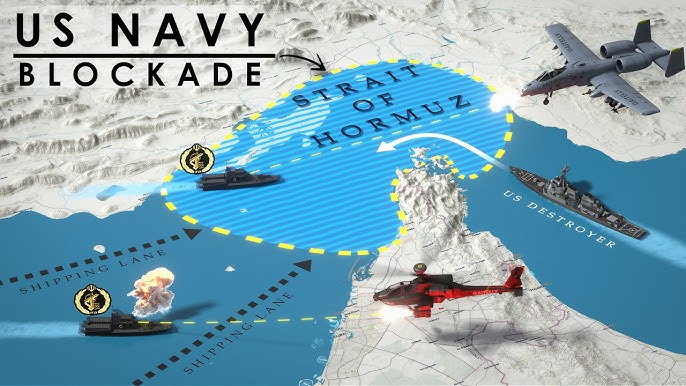
The military attack by the superpower USA and its proxy in the Middle East, Israel, against Iran has created a special situation. The Iranians are exploiting their geographical position, not by sealing the Straits but by implementing a selective blockade. The Straits remain open but only for about 10 to 15% of the pre-war traffic. The credible threat of attack (by missiles, drones, or small speedboats) is enough to blow up the insurance market for war risk coverage. Fares become expensive, the risk becomes unprofitable and the flow of oil is interrupted. And we all know what happens when we have an interruption in the flow of a central artery of the human body: Heart attack and stroke!
That is exactly what happens. Global markets are beginning to feel sharp pains that portend a heart attack, and the US and its allies are sharing their brains as the conflict becomes fundamentally asymmetric: easy and cheap for Iran, as opposed to very difficult and extremely costly for the aggressors.
A key feature of modern economies is that they don’t just need oil. They need large-scale oil, delivered on time and with predictable prices and risks.
In a war, realities are born. A harsh reality born in this war is that: without Iran’s consent or at least its tolerance, the free flow of energy cannot be ensured. This is the real reason why Iran explicitly demanded an end to Israeli attacks on Lebanon and immediately the US gave exactly what it asked for. Making Iran a new player in the new prescribed World Order.
The system that was in place until now for the passage of ships in the region has collapsed, with the fault of the US.
The Gulf states (Saudi Arabia, UAE, etc.), which depend heavily on energy export revenues, are seeing immediate fiscal consequences from the increase in insurance and freight costs. They are forced to adapt: they are redirecting cargoes, renegotiating contracts and, in the long term, coming to terms with the factor that can directly affect the reliability of their exports — Iran.
The consequences are particularly acute in Asia. Countries such as Japan, South Korea and India are highly dependent on Gulf oil. China imports a significant part of its energy from the region but is less affected as it continues to be supplied. These needs are tied up in inelastic infrastructure (refineries, ports, storage facilities). If the disruption lasts for months or years, it will cause higher energy prices, worsening trade balances, weakening currencies, rising inflation and stagnation. It will be reminiscent of the oil crises of the 1970s, with long-term stagflation.
The only ones who benefit
The only ones who benefit from the situation are the “rival poles” of the US, namely China and Russia. And of course Iran through leverage in the Straits. And they don’t even have to be in a formal alliance! Their converging interests shape the new world order and make room for the new player, Iran.
It is certain with mathematical precision – literally – that if the situation drags on, Europe will be forced to remove its political blinders and approach Russia as an energy partner and not as an enemy. Just as it is certain that then the Russians will sell more expensively… The consequences for the West are catastrophic. Making the US geopolitical nightmare, the unification of Eurasia, a reality.
The power of the US is dramatically reduced. So they are faced with a dilemma. Engaging in a long-term military conflict for control of the Straits or accepting a new energy geopolitical reality?
But is this a false dilemma? The US carries a federal debt of approximately 40 trillion – created mainly by wars – which increases by almost 120,000 dollars every second! How can they support a chronic and costly war? Israel, of course, does not contribute to the solution of the problem since it constitutes another cost point for the US and is militarily negligible in itself in relation to the US.
Through the prism of all of the above, it is understandable why Iran’s explicit condition for a cessation of hostilities in Lebanon was completely accepted.

