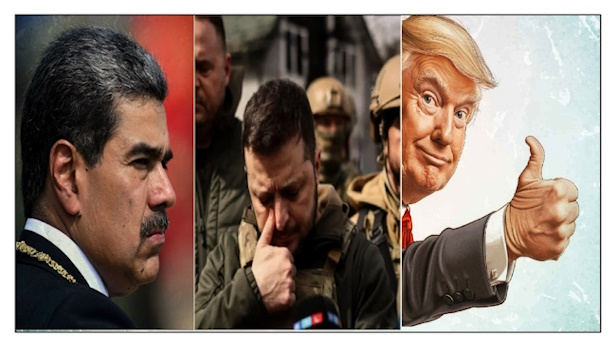
It is extremely interesting to observe world affairs in different latitudes and latitudes in order to compare them. What is striking from the outset is that double standards are almost always used, each time more shamelessly.
Let us take the case of Venezuela and Ukraine as an example. The US is determined to pressure Venezuela to submit by any means possible to an informal Monroe Doctrine of the 21st century. The arguments with which it justifies are that President Nicolas Maduro is illegitimate, that he collaborates with Russia, that he supports socialism or, worse, communism, and that he turns a blind eye to drug trafficking to the US. These points are enough to categorize Venezuela as a threat to US national security.
Reflecting these arguments, Russia could claim about the president of Ukraine, that Volodymyr Zelensky has been in office illegally for more than twelve months, that he is cooperating with the West and NATO (sworn enemies of Russia), that he is funding neo-Nazis and that his government has murdered thousands of Russian-speaking Ukrainian citizens. That is, that Ukraine is a threat to the national security of the Russian Federation.
Just as the US (so far) supports military intervention in Venezuela, Russia does not need to do so, as it is already militarily involved in Ukraine.
The US claims that its intervention in Venezuela is legitimate, while what Russia is doing is completely wrong.
The geographical difference, of course, is that the distance between Venezuela and the US is much greater than that between Ukraine and Russia. However, the US feels threatened, while Russia should not.
A simple question arises: Why might Washington view Venezuela as a threat to US national security, while Moscow should not view Ukraine as a threat to the national security of the Russian Federation?
We can easily imagine possible explanations offered by the mainstream media. Namely: Ukraine is a peace-loving, democratic country, while Venezuela is neither peace-loving nor democratic. Ukraine certainly did not pose a threat to Russia, and vice versa. The US, although it verbally threatens Venezuela on a regular basis, of course does not actually threaten it, but issues friendly admonitions or friendly advice? Furthermore, the US is known worldwide for its political honesty and fairness, while Russia is not. On the contrary, Russia is known for its aggressive policy and duplicity. Nicolas Maduro is certainly not liked by Venezuelans, while Vladimir Zelensky enjoys immense popularity. The US acts with sound political and moral principles, while Russia acts on behalf of the old Russian and Soviet imperialism in which land grabbing and regime change are inalienable policies.
Continuing the parallels: If an American president can think of military intervention in a neighboring country because of the drug cartels operating there, why can’t his Russian counterpart think of and then carry out such a military intervention in a country bordering Russia? The Ukrainian case is more important to Russia than drugs, as this country has been a hotbed of anti-Russian military and ideological activities, guided, maintained and supported by NATO experts and advisors. What would Washington do if Venezuela, Mexico or any other Latin American country had military advisors from Russia and China? Yes, you guessed it right.
So why are things viewed through such diametrically different lenses?