




In spite of what is being written about a new dynamic that is – supposedly – taking shape politically in the eastern part of Europe, for example through the new “confidence” given by the war in Ukraine and the involvement of the West in countries like Poland, when we talk about economy, the heart of the European economy remains German. And when things don’t go so well with the German economy, then all of Europe is worried.
In the immediate past, there had been an attempt to paint a picture of optimism centered on Germany avoiding the technical definition of recession, i.e. two consecutive quarters of contraction, as the first quarter of 2023 would mark a return to growth.
In this direction, various forecasts from economists and the first figures for Germany’s GDP in the first quarter of 2023 that were released on April 23 showed that we had a stagnation, but that was an obvious improvement in relation to the contraction 0.4% that was recorded in the last quarter of 2023. The final official data is expected on May 25, but a feeling of optimism had formed.
The decline in industrial production in March
But the sequence of optimistic messages about the growth of the German economy was interrupted by the announcement of the data on industrial production in March.
According to them, industrial production in Germany fell by 3.4% in March 2023, the biggest decline in 12 months. This was a far worse performance than economists had predicted, which had put the decline at just 1%.
Of course, experts were quick to note that even so, industrial production in the first quarter remained 2.4% higher than the previous quarter. But the fact that the decline is recorded in the last month of the quarter raises concern about economic momentum in the second quarter.
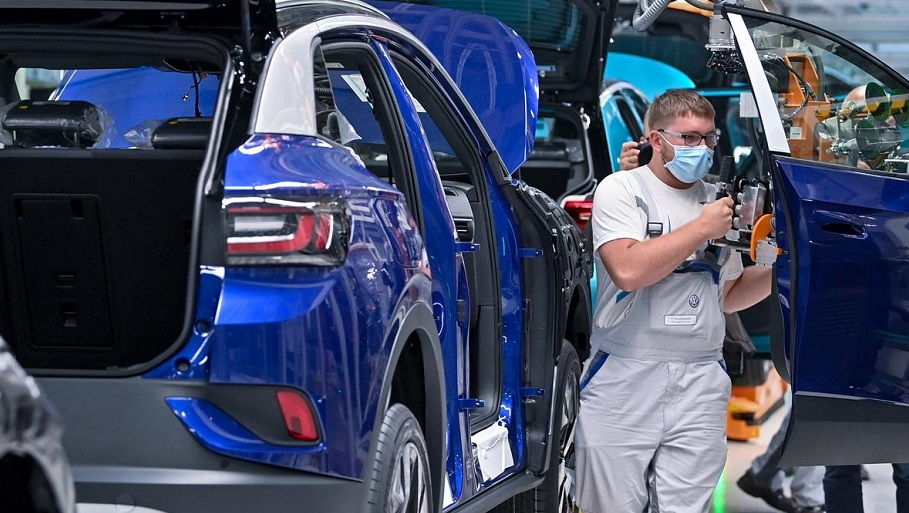
The decline in industrial production was sharper in the automotive industry, where the decline reached 6.5%, while machinery and equipment manufacturers had a decline of 3.4%, while in construction the decline was 3.6%.
Even greater pessimism was born by the fact that not only has industrial production in Germany failed to return to pre-pandemic levels, but also in March we had an impressive 10.7% decline in factory orders, the largest monthly decline from April 2020.
However, in other indicators we also had a decline in March. Retail sales fell 2.4% in March in Germany, while German exports also fell 5.2% from the previous month.
All this came shortly after German Finance Minister Robert Habeck announced more optimistic forecasts, raising the bar for growth this year from 0.2% to 0.4%, saying energy subsidies helped.
However, there are now increasing indications that Germany will hardly avoid recession this year, given the importance of industrial production in its economy.
Persisting inflation and the other problems
Inflation in Germany was at 7.4% in March 2023, an increase of 0.8% compared to the previous month. This was a decline compared to the previous two months when the Consumer Price Index was at 8.7%.
But even so, 7.4% is still quite a high figure, and it is interesting that despite the German government’s measures to reduce energy costs, household energy prices nevertheless continued to rise in March in Germany. On an annual basis, energy prices for German households increased by 21.9% compared to the same period, mainly due to the significant differences in the price of natural gas. In addition, there was an acceleration in the rise in food prices.
But structural inflation, i.e. that which results if we do not include energy and food, also remains high at 5.8%. The combination of persistent inflation and successive interest rate hikes is actually shaping a wider range of negative pressures on the German economy.
The problems didn’t start now
Although some of the problems can be considered topical, mainly because they have to do with the war in Ukraine, it is nevertheless clear that the problems of the German economy are more structural.
In fact, an entire economic model that was created in the post-war period is currently being called upon to transform, and especially at a particularly rapid pace.
Germany is quite behind in the extent to which it has made the “Green Transition”, while paying dearly for the war in Ukraine in terms of energy costs. At the same time, the pace of its digital transformation is considerably slower than it should be. And of course it has to face problems from demographic dynamics, as a large part of its skilled workforce is over 50 (sometimes over 60), without it being clear how it will be replaced by a similarly skilled workforce now that the previous generation is on its way towards retirement.
Added to all this is the overall problem of international orientation. A return to economic transactions with purely “Western” countries would create several problems, hence the effort to maintain upgraded relations with China. But a transition to a more fragmented world will also mean economic problems for Germany.


