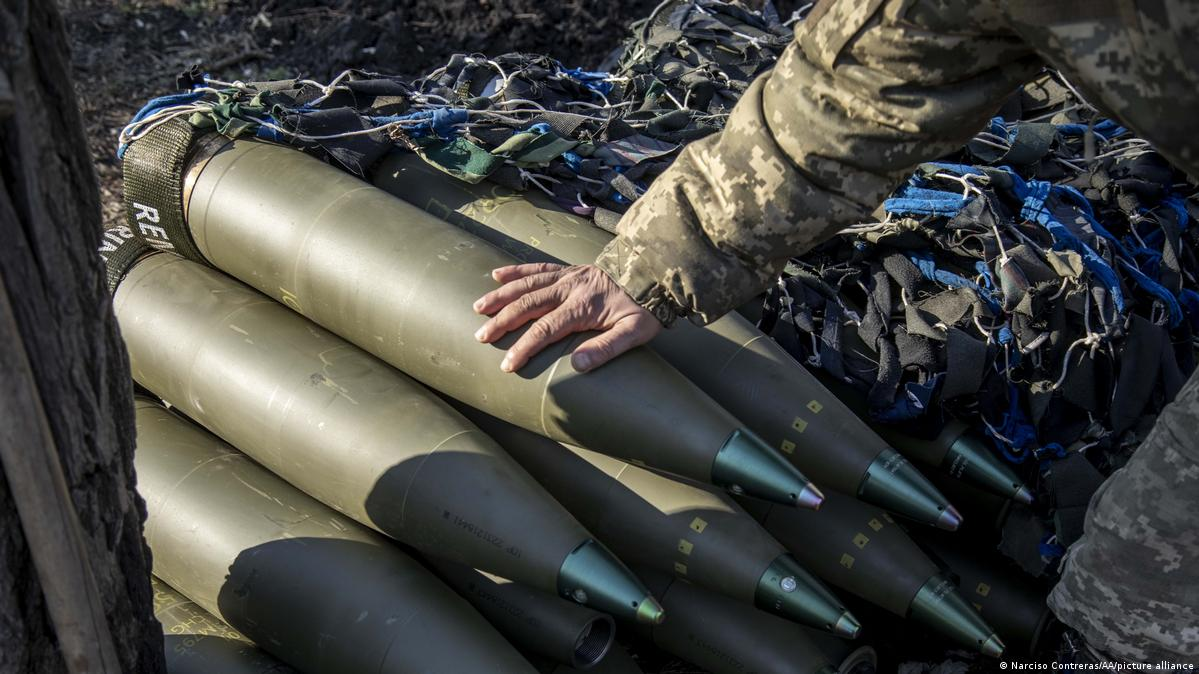
It is well known that one of the most serious problems currently facing both the Ukrainian government and the Western governments that support it is the lack of ammunition. And that’s because the particular form the war in Ukraine has taken, which is essentially a war of attrition with extensive artillery use, means that each side is firing thousands of missiles at the other every day.
And if Russia manages not to have a problem, mainly because it has a great production depth in its war industry and thus may not have supply problems, the same is not true for the Ukrainian side, where there is concern that even with the increasing military aid that has from mainly western countries. And the biggest shortage is expected to be seen in the 155mm projectiles which are primarily used in Ukraine.
And this is where the European Union itself takes action, through two parallel and complementary initiatives. But at least one of the two is very likely to violate the Treaty of the Union itself, which prohibits the use of the EU budget for military purposes.
Recent European initiatives to support Ukraine in ammunition
The EU’s first initiative to be able to militarily reinforce Ukraine concerns a mechanism outside the Union’s budget. This is the European Peace Facility (EPF), which was decided by Council Decision 2021/509 of 22 March 2021 and aims to finance actions concerning the Common Foreign and Security Policy and which are related with defense and with military operations.
This mechanism is not financed from the budget, but is based on the direct contribution of the Member States each time. Its total budget (spend limit) is €7,979,000,000 for the period 2021-2027 with the annual spending “ceiling” ranging from $399 million in 2021 to $1.434 billion in 2025.
Last March EU foreign ministers agreed in principle to deliver through this mechanism one million artillery shells and missiles over a 12-month period. But it took quite a lot of hard negotiations before member states could settle on a concrete form. A first confrontation, which even brought the representatives of France and Poland into conflict, was the insistence of Paris that the relevant contracts should be limited to companies from the EU and not to companies outside the EU, e.g. from the USA or Great Britain. The final agreement was to limit supplies to companies from the European Union and Norway, a country with close ties to the EU. However, several countries remain unhappy, including the Baltic and Eastern European countries as well as Germany and the Netherlands. Germany fears that because German companies import many necessary components from Britain, they will eventually be excluded from the financing, which will total one billion euros.
The second initiative came from the European Commission and does not concern the off-budget European Peace Mechanism, but the budget itself. The plan was presented on May 3 by representatives of the European Commission and concerns the use of 500 million euros from the Union budget to effectively give subsidies to the European defense industry so that it can increase the production of artillery shells and missiles with the final recipient being the armed forces of Ukraine.
For the President of the European Commission, Ursula von der Leyen, these two initiatives, combined with the decisions of the member states themselves to offer ammunition and armaments to Ukraine, form three main axes of support for Ukraine from the EU.
“Ukraine is heroically resisting the brutal Russian invader. We keep our promise to support Ukraine and its people for as long as necessary. But the brave soldiers of Ukraine need adequate military equipment to defend their country. Europe is stepping up its support in three directions. First, member states are delivering additional ammunition from their existing stockpiles, with new support from the European Peace Fund of €1 billion. Secondly, together with the Member States, we will jointly procure more ammunition for Ukraine – and we have an extra billion euros available for this. And today, we implement the third leg. We are strengthening and accelerating the defense industrial production of ammunition in Europe.
This will help supply Ukraine with more ammunition to defend its citizens and will also strengthen our European defense capabilities. Together with Member States, we will mobilize an additional €1 billion to increase capacity across Europe. This is a critical part of Europe’s strategic ability to defend its interests and values and contribute to maintaining peace on our continent.”
The content of the third axis is contained in the “Proposal for a Regulation of the European Parliament and of the Council establishing the Ammunition Production Support Act”, published on 3 May.
The content of the third axis is contained in the “Proposal for a Regulation of the European Parliament and of the Council establishing the Ammunition Production Support Act“, published on 3 May.

The problem with the Union Treaty
But there is a problem with using EU budget money to subsidize industries that produce military equipment. And this is because the Treaty of the Union itself puts limitations on the expenditure related to such supplies.
In Chapter 2 of the Treaty on European Union, the “statutory charter” of the EU, entitled “Special provisions on the common foreign and security policy”, in Article 41(2) it is expressly stated that:
“Operational expenditure resulting from the implementation of this chapter shall also be charged to the budget of the Union, except for expenditure due to actions having military or defense consequences and cases where the Council unanimously decides otherwise.
In cases where the costs are not charged to the Union budget, they are borne by the Member States according to the gross national product key, unless the Council unanimously decides otherwise. With regard to expenditure due to actions having military or defense consequences, Member States whose representatives in the Council have made a formal declaration pursuant to Article 31, paragraph 1, second subparagraph, shall not be required to contribute to their financing».
This “other than expenditure due to actions having military or defense consequences” is seen as effectively banning the EU from using budget money to subsidize defense industries to produce more munitions.
The European Commissioner for the internal market, Thierry Breton himself, stated that “our analysis is that the proposal is fully compatible with the treaty” and that “investing in our defense will help us defend our democracy. And this is what we must tell our fellow citizens.” However, other diplomats in the EU argue that the treaties expressly prohibit funding for weapons systems. And it is not without significance that Breton is French, meaning he represents a country with a strong defense industry that would like to see these very subsidies granted. In fact, recently Breton made a tour visiting EU defense industries.