


According to market circles, the situation appears to have been orchestrated, with Wall Street reacting by pricing in significant volatility.
Meanwhile, within Washington’s political corridors, there is speculation that the removal of Jensen Huang serves broader geopolitical objectives—suggesting that Donald Trump may have made a strategic sacrifice to maintain the balance of power within the semiconductor industry.
Reports that the Board of Directors was meeting to consider his potential ouster triggered another sharp decline in the stock.
Specifically, the share price fell by approximately 8% in after-hours trading that day, compounding losses that ultimately amounted to hundreds of billions of dollars in market capitalization.
At the same time, the lack of a clear succession plan—following Huang’s 33-year tenure as co-founder and sole CEO—has come to the fore. And that brings us to the present day. This morning, the Board of Directors announced his immediate resignation from his positions as Chairman, CEO, and member of the Board.
The company’s Chief Financial Officer, Colette Kress, has been appointed interim CEO, while continuing to fulfill her financial responsibilities.
Harvey C. Jones has assumed the role of the first Chairman of the Board in the company’s history, as the search for a permanent successor begins.
This development leaves the artificial intelligence industry and international markets facing significant uncertainty. Naturally, Jensen’s contribution to NVIDIA has been pivotal and invaluable.
NVIDIA ranks among the most influential technology companies globally. The Board of Directors and the company express their gratitude to Jensen for his invaluable contributions—both to the company itself and to the broader technology sector.
Market Reaction
Nvidia currently has a market capitalization of approximately $4.19 trillion; however, since November 8—when scandals of a sexual nature involving its founder and long-time CEO, Jensen Huang, came to light—the company has experienced a decline of more than 10% (or $450 billion).
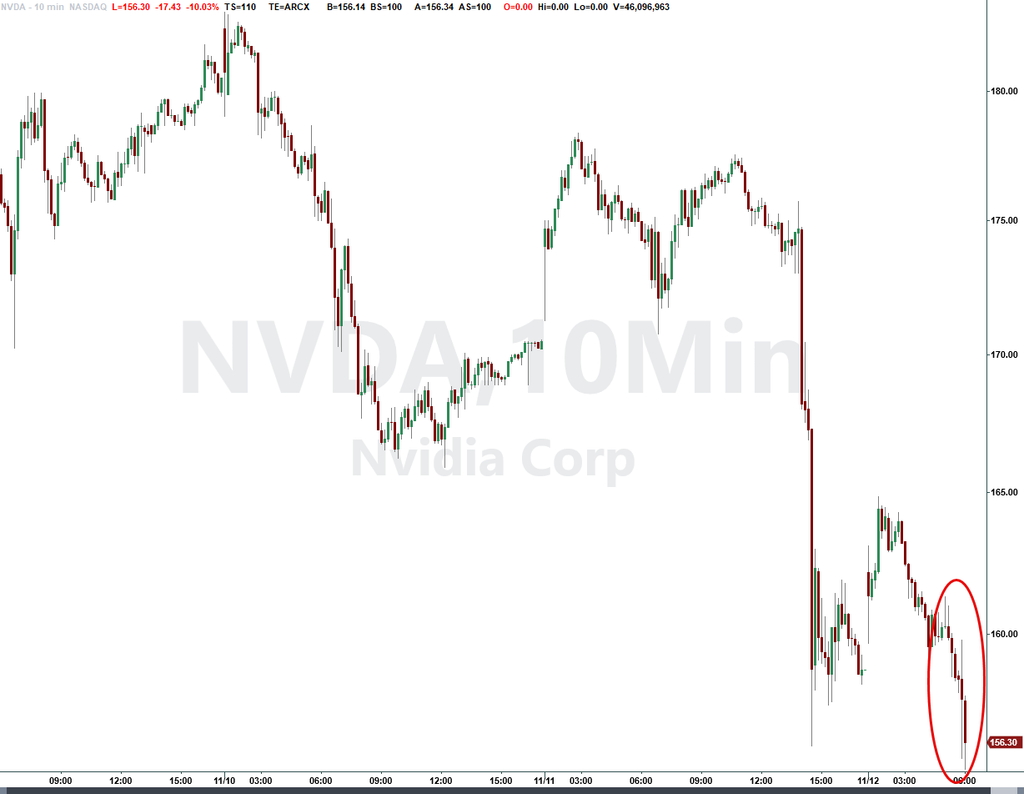
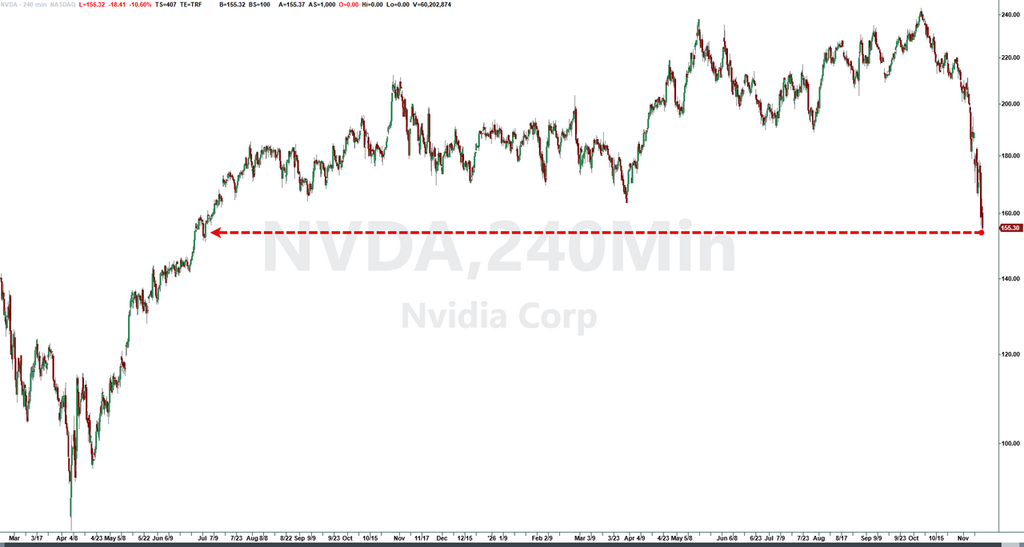
This development pushes the share price ($151) to its lowest level since July 2025, marking a decline of over 35% from its all-time highs.
Wall Street has kicked into gear to take aim at one of the world’s largest bubbles. To be clear: we are not saying that Nvidia isn’t a good company—quite the opposite.
However, its market valuation is unjustified. In fact, one could describe it as a massive bubble—one that simply bakes in extremely optimistic expectations regarding the future growth of artificial intelligence, as well as the political connections of Jensen Huang.
Here is the explanation:
- There is an undeniable disconnect between capital expenditure (CapEx) and actual utility (revenue generation).
- Tech giants are pouring hundreds of billions into infrastructure and Nvidia chips, yet revenue from end-use AI applications is not growing at the same pace.
- There is a looming fear of “dark GPUs”—chips that end up sitting idle and unutilized, much like the fiber-optic cables left dormant back in 2000.
- Furthermore, a massive portion of Nvidia’s revenue is derived from just four or five companies (Microsoft, Alphabet, Meta, and Amazon).
- If even one of these firms slows down its purchasing or develops its own proprietary chips, Nvidia will take an immediate hit. Critics point out that a large portion of the funds is recycled within the same ecosystem (e.g., investments by Nvidia or Big Tech companies in AI startups, which subsequently use these funds to purchase Nvidia chips).
Even though there is demand for chips, the expansion of data centers is now running up against shortages in electricity, grid infrastructure, and permitting—factors that could delay both deliveries and revenue.
What do the stock market indices say?
Nvidia is now worth over $4 trillion. At this scale, the mathematics work against future returns.
For an investor to double their money from this point forward, Nvidia would need to reach a valuation of $8.4 trillion—an amount that exceeds the combined GDP of many major nations.
The scope for explosive, exponential growth (alpha) is narrowing dangerously, simply due to the company’s massive size.
The current P/E ratio of ~22 is relatively low for a high-tech company with such growth rates (typically, such firms trade at P/E ratios above 30–40).
However, a low forward P/E does not necessarily mean the stock is “cheap.” It implies that analysts have already priced in massive earnings for the coming years.
The P/S (Price-to-Sales) ratio stands at 13.85; this means that for every $1 of revenue Nvidia generates, investors are paying nearly $14 in the stock market. The company is valued like a high-margin software (SaaS) firm rather than a chip manufacturer—a sector traditionally subject to cyclical fluctuations and high R&D capital costs.
Its price-to-free-cash-flow (P/FCF) ratio stands at 33; in other words, investors are paying $33 for every $1 of actual cash (Free Cash Flow) that remains in the company’s coffers after its investments.
This is arguably the most critical metric.
A P/FCF of 33 implies a free cash flow yield (FCF Yield) of approximately 3% ($1 / $33).
When safe U.S. bonds or bank deposit rates offer comparable returns with minimal risk, Trust Economics considers a 3% yield from a high-tech, high-risk stock to be overvalued.
It should be noted that Nvidia is engaging in massive share buybacks, having approved a record-breaking program with a total authorized value of $235 billion (following a $150 billion increase in September 2026).
The company has already spent approximately $40.1 billion in fiscal year 2026 and $39.8 billion in the first half of fiscal year 2027 alone.
When a company repurchases and cancels its own shares—reducing the share count by a net total of approximately 157 million during the first half of FY2027—net earnings are divided by a smaller number of shares.
Consequently, earnings per share (EPS) are artificially inflated (with an estimated additional boost of 2.3%–3.2% from the $150 billion tranche alone), making the P/E ratio appear more attractive, even though actual operational profitability has not increased.
With a repurchase pace of nearly $20 billion per quarter, Nvidia itself acts as the largest and most consistent buyer of its own stock, absorbing selling pressure whenever investors move to lock in profits.
A large portion of these billions does not actually reduce the share count; instead, it merely absorbs the new shares issued by the company as stock-based compensation for its executives and employees.
In the first half of 2027, Nvidia generated $69.9 billion in free cash flow and spent nearly 57% of it ($39.8 billion) on repurchasing its own shares at historically high valuations.
Furthermore, fully executing the $235 billion buyback program over 16 months would require approximately $44 billion per quarter—an amount that exceeds the company’s current quarterly cash flow ($21.3 billion in the second quarter). Consequently, the announcement functions, in part, as a psychological “stunt” designed to support the share price.
Nvidia’s ‘fabricated’ sex scandal involving a Chinese spy
The dark truth is that Washington is using this personal drama as a smokescreen to conceal a catastrophic strategic defeat in the semiconductor war—a war it initiated itself.
In other words, what is unfolding before our eyes serves a specific purpose: to divert our attention from the real issue.
The U.S. has failed in the economic war it launched against China, and the architects of this failure are in need of a scapegoat.
This was not a matter of national security, but rather a disagreement over government policy.
Huang was winning the argument in question, and the U.S. national security apparatus needed to take him out of the game.
The narrative about an “affair with a spy” serves the exact function of a cheap magic trick: it directs public attention toward the scandal, while the real loss is taking place elsewhere.
In this instance, that loss is the failure of the American “Pax Silica” strategy.
Washington’s plan to keep China dependent on American technology through export restrictions has had the exact opposite effect. China has accelerated its push for technological self-sufficiency. Companies such as SMIC have managed to mass-produce 5nm-class semiconductors, while Huawei is spearheading a domestic initiative to develop chip-manufacturing equipment.
The U.S. strategy under the Trump administration proved to be a “gift” that accelerated China’s technological independence.
The failure of this strategy constitutes a serious geopolitical defeat—one that the establishment finds difficult to admit.
▪ The military-industrial complex needs an enemy
The narrative of a “Chinese threat” is used to justify massive Pentagon budgets and the expansion of the surveillance state.
A CEO who demonstrates that this threat is being grossly exaggerated poses a risk to this entire ecosystem.
The scandal serves as a weapon to discredit him and preserve the existing narrative.
▪ The illusion of “Pax Silica”
The U.S. launched the “Pax Silica” initiative, aiming to form an alliance of nations that would decouple their supply chains from China.
However, when you force supply chains to abandon regions that offer the most favorable economic conditions, you are choosing inflation over economic integration.
The semiconductor war places a burden on the American economy, drives up production costs, and weakens other industrial sectors.
▪ Trump’s Political Pattern
As his agenda in the Middle East remains stagnant and the trade war unfolds to the detriment of the U.S., Trump resorts to diversionary tactics.
When he cannot secure a victory, he creates a media spectacle.
The Nvidia scandal serves as a prime example of a “wag the dog” operation: an artificially inflated foreign policy issue used to distract from domestic failures and electoral vulnerability.
The Core of the Matter
The “Chinese spy” is a phantom. The real target is Jensen Huang—the CEO who, according to this narrative, has exposed the failure of the semiconductor war launched by Washington.
The crux of the matter, as presented here, is that the United States is losing the technological contest; that the strategy of economically containing China has yielded results opposite to those intended; and that the political leadership is using a personal scandal to mask the collapse of its own geopolitical strategy.
The media spectacle is deafening. Equally deafening, however, is Washington’s silence regarding its strategic defeat.
The American economy is footing the bill for this failure. And, according to this analysis, the proof lies in a “semiconductor scandal”—one allegedly orchestrated for a single purpose: to prevent the public from having to confront the true toll.
The beginning of the end for the Artificial Intelligence bubble?
It should be noted that these losses—and the talk of a “bubble”—are not limited to Nvidia. Last week, many stocks of companies active in the Artificial Intelligence sector took a major hit.
The hardest hit, by far, were the so-called “neo-clouds” (next-generation cloud infrastructure companies), while several major chipmakers also recorded significant losses.
In contrast, the companies that dominate the large-scale cloud services market—the “hyperscalers”—appeared to be barely affected. Let’s look at some indicative figures:
- CoreWeave, the largest of the neo-cloud companies, fell by 15.4%, bringing its year-to-date decline to 56.6%.
- Iren lost 9.7%, and is down 67.7% compared to the same period last year.
- Nebius had the worst week, with a 16% drop, bringing its total losses over the past twelve months to 18.3%. Among microchip manufacturers, Micron recorded the largest weekly decline, losing 22% of its market value. Nevertheless, it remains up 189.5% on an annual basis.
- The week was also extremely negative for Intel, whose stock fell by 14.4%, although it remains 51.2% higher compared to last year.
Major cloud service providers—or “hyperscalers”—were largely unaffected by the end of the week,
- though Alphabet experienced a sharp drop the day after the election. Overall, however, its stock rose by 2.1% for the week.
- Amazon saw a gain of 7.9%, while Microsoft rose by 1.7%.
- Meta experienced a slight decline, losing 0.8% of its value.
- The only notable exception was Oracle—by far the smallest of the hyperscalers and the only one lacking another highly profitable business segment (beyond Artificial Intelligence) upon which it could rely. Its stock fell by 11.2% last week and has recorded losses of 52.4% on an annual basis.


