



Saudi Arabia is on a trajectory toward total collapse, as the sweeping alliance between Iran and Yemen corners Crown Prince Mohammed bin Salman—irreparably—and shatters the balance of power in the Persian Gulf.
Meanwhile, Washington watches these developments in alarm, witnessing the unraveling of Pax Americana and the relentless approach of an unprecedented global energy shock.
The UN Meeting
The Americans intended to appease the representatives of the Global South gathered in New York—who were in a state of stupor—and to woo them with all manner of “gifts.”
In doing so, they hoped to divert attention from the looming Great Catastrophe and mask the astonishing speed at which Pax Americana was collapsing.
Cut to Wednesday—the opening day of the UN General Assembly debate—where Donald Trump is scheduled to deliver a speech. That same day, he meets with the oil sheikhs of the Gulf region for what could well prove to be a suicide pact.
Then, on Friday, Xi Jinping arrives in the US in person for an official state visit. Sparks—invisible yet potent—will undoubtedly fly. All this would have guaranteed that the almost inevitable new, irrational attack against Iran and the Axis of Resistance would be postponed for a few days.
But then hysteria struck again, as panicked figures found themselves facing a series of shocking events on the ground—from Saudi Arabia’s zero oil exports to the cry of “fire” at Riyadh airport.
It seems they realize that a new attack on Iran now poses an existential threat to them, because the escalation could spiral completely out of control, resulting in Tehran permanently eliminating the terrified oil sheikhs.
Thus, they discovered the hard way that, come what may, Iran is destined to become the oil hegemon of the Persian Gulf.
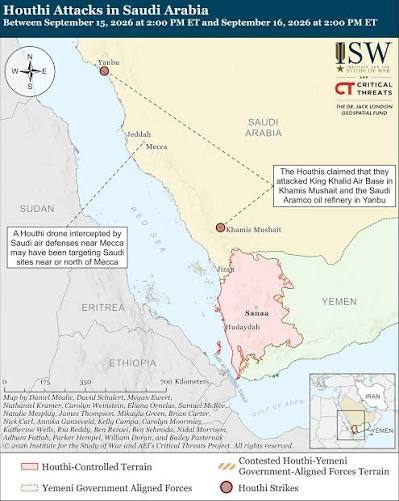
And then, Pakistan and Turkey—the other two members of the highly controversial “Alliance for the Defense of Mecca”—collectively lost their composure and even pledged to defend Saudi Arabia militarily. Addressing the broader context, Ansarallah representative Mohammed Al-Bukhaiti speaks:
“By God, if Turkey or Pakistan intervene, we will deal them a heavy blow. And just as we are currently confronting Saudi Arabia, we will confront them too.” This was the “friendly” advice from the elder Al-Bukhaiti.
The younger one, Hussein—a journalist—was far more radical: if Pakistan attacks Yemen, Yemen will not allow a single Pakistani merchant vessel to sail in the Red Sea, will launch a direct attack against Pakistan, and will regard Pakistan as a Zionist partner.
The Fall of the House of Saud
We have now reached the point of escalation. An energy shock is imminent. All margins of safety have vanished: US Strategic Petroleum Reserves (SPR), the Saudi East-West pipeline—out of commission for at least a month, perhaps longer—and the methodical, substantial reduction in oil imports by China.
What remains is Fujairah in the UAE, where processing capacity stands at a mere 2 million barrels per day.
However, should the US attack the Axis of Resistance, even this option would vanish in the blink of an eye. Saudi Arabia would no longer be able to export oil or natural gas. Consequently, there is only one way out for the clumsy and isolated decision-maker, MbS: surrender.
He must accept Yemen’s terms and await the bill that will include the three southern provinces—territories the British seized in 1934 and subsequently ceded to the Saudis.
Failure to surrender means the chances of the House of Saud surviving are extremely slim. The lightning campaign by the Ansarallah movement and the Yemeni armed forces was waged seven years ago. Sana’a is operating with a very long-term vision. This entails Yemen’s full participation in the process, leading to an outcome that aligns perfectly with Tehran’s.
There is a striking parallel with the situation in Afghanistan five years ago. Ghani’s puppet government collapsed in just ten days, thanks to patient cooperation among Pashtun tribes, orchestrated by General Soleimani.
The same process is now unfolding, but with Arab tribal leaders. The argument is simple. The state of “Saudi Arabia” was built around an ultra-sectarian Wahhabi core—a group of illiterate Bedouin camel herders—where a single family monopolized wealth, political power, and the entire decision-making process.
Many of the roughly 100 tribes could seamlessly join a process in which the Kingdom is integrated into what might be termed the Iran–Ansarallah bloc. They would reclaim their oil.
Arabia would no longer be confined to the role of an American proxy standing in for Persian power. And this would spell the end of the “free lunch” for American oil companies. China can only approve of this vision.
The petro-sheikhs have chosen their side
Sanaa has sent a clear message to the US via Oman: Yemen will attack only Saudi vessels, not American or international ones. This holds true provided that Washington does not attack Yemen.
However, should such an attack occur, Yemen would destroy the US base in Djibouti, which is vital for surveillance across the entire Horn of Africa.
The critical question now is whether the US—and the Mecca Agreement—have truly abandoned Saudi Arabia. Or is this merely a ruse preceding a coordinated attack against the Ansarallah movement, involving the Gulf Cooperation Council?
Should this happen, Tehran has made it clear that it will strike US military and commercial targets throughout the Gulf region—particularly in the UAE and Saudi Arabia—extending as far as Iraq. Major General Mohsen Rezaei, Secretary of Iran’s Supreme National Security Council and personal representative of the Leader, Mojtaba Khamenei, described the situation in a single sentence:
“We invited them [the GCC countries] to the meeting in Salalah [Oman]… and they responded with a secret meeting in Germany involving US Central Command and Israel.”
It is all there. Iran invited the GCC oil sheikhs to a joint regional negotiating table. However, the GCC chose the table of Washington and Tel Aviv instead.
Rezaei also described how Iran has upgraded its hypersonic missiles from Mach 6 to Mach 10, expanded its electronic warfare and air defense capabilities, and is now capable of striking US ships anywhere in the distant Indian Ocean.
Then there is the missile capable of attacking ships and splitting into 80 warheads—a test that, according to relevant claims, was successfully conducted against a US aircraft carrier. The Pentagon remains completely silent on the matter. Rezaei has discreetly advised the US Navy—in more ways than one—to withdraw from the Indian Ocean before tensions flare up again.
Then, young al-Bukhaiti speaks again: “A significant escalation by Saudi Arabia is expected in the coming day or days… This will be met with a stunning retaliatory action, making Saudi Arabia and its allies forget that they lost Mocha and Bab al-Mandab.” Iran and Yemen are inextricably linked.
Respect Iran’s terms. Otherwise…
Tehran has conveyed its new terms to the US via Qatar, while Rezaei continues to describe the “respected Pakistani government” as a reliable negotiating partner.
The terms include the unfreezing of assets and the end of the naval blockade imposed under Trump. Rezaei stated there are seven terms but revealed only six.
The list made no mention of “lifting economic sanctions.” The main point publicly demanded was “an end to the war on all fronts.”
This is precisely what was mentioned at the beginning of the Memorandum of Cooperation regarding the “dead cat.” The June Memorandum of Understanding already included exemptions for crude oil exports, as well as a clause prohibiting the imposition of new sanctions. Then there is the issue of reciprocity regarding the Strait of Hormuz.
This is part of Tehran’s negotiating framework. Iran is “just a small step away” from announcing a management agreement for the Strait of Hormuz with Oman, which may require regional approval.
The agreement represents “a step toward Iranian sovereignty over the Strait of Hormuz.” At the same time, Foreign Minister Araghchi told his counterpart and friend Wang Yi in Beijing that Iran “has reached a plan with Oman to open the Strait.”
Ghalibaf subsequently reiterated on Sunday that the Strait of Hormuz remains closed until Iran’s conditions are met. Washington’s response on Sunday was, as usual, irrational rhetoric. Donald Trump stated on Fox News that he was in a “decision-making phase.”
And then he made a truly major mistake: he was deciding “whether and when to blow up the entire country.” No comment is needed. Essentially, he has three options:
- New attacks.
- Letting Iran “rot” economically—this is the plan for now.
- A deal.
Very wisely, he also said that he “would probably be open” to a meeting with President Pezeshkian during the UN General Assembly. However, a meeting did take place between Witkoff and Araghchi.
The Iranian armed forces, for their part, claimed to have intelligence that Washington had decided to resume operations “with the approval of certain countries in the region” and threatened “continuous, effective, and painful attacks.” Regarding the broader picture, Pakistan has emphasized that no military response in Yemen is under discussion. Turkey “does not wish to get involved in the conflict.” Nevertheless, the Pakistani military spokesperson has vowed to go to “great lengths,” while the Foreign Ministry has confirmed “certain troop movements” within the framework of the Mecca Defense Alliance.
Liberal Globe sources in Islamabad claim this is merely for show: Pakistan cannot afford to be dragged into a war against Ansarallah. The crux of the matter is that the US and Israel simply do not have the luxury of remaining idle.
Consider the difficult circumstances: they are already grappling with a currency collapse, the breakdown of the food supply chain, and widespread shortages of oil and diesel. They require massive diversionary tactics.
Meanwhile, the revolutionary resurgence in Yemen is accelerating the timeline of the confrontation. While Iran focuses on achieving a decisive defeat, it is simultaneously working on its new offensive doctrine: being prepared to launch a preemptive strike against any sign of American unrest. It is almost impossible to find logic in an irrational geopolitical universe where nothing matters and the Global Hegemon has completely lost control.
