



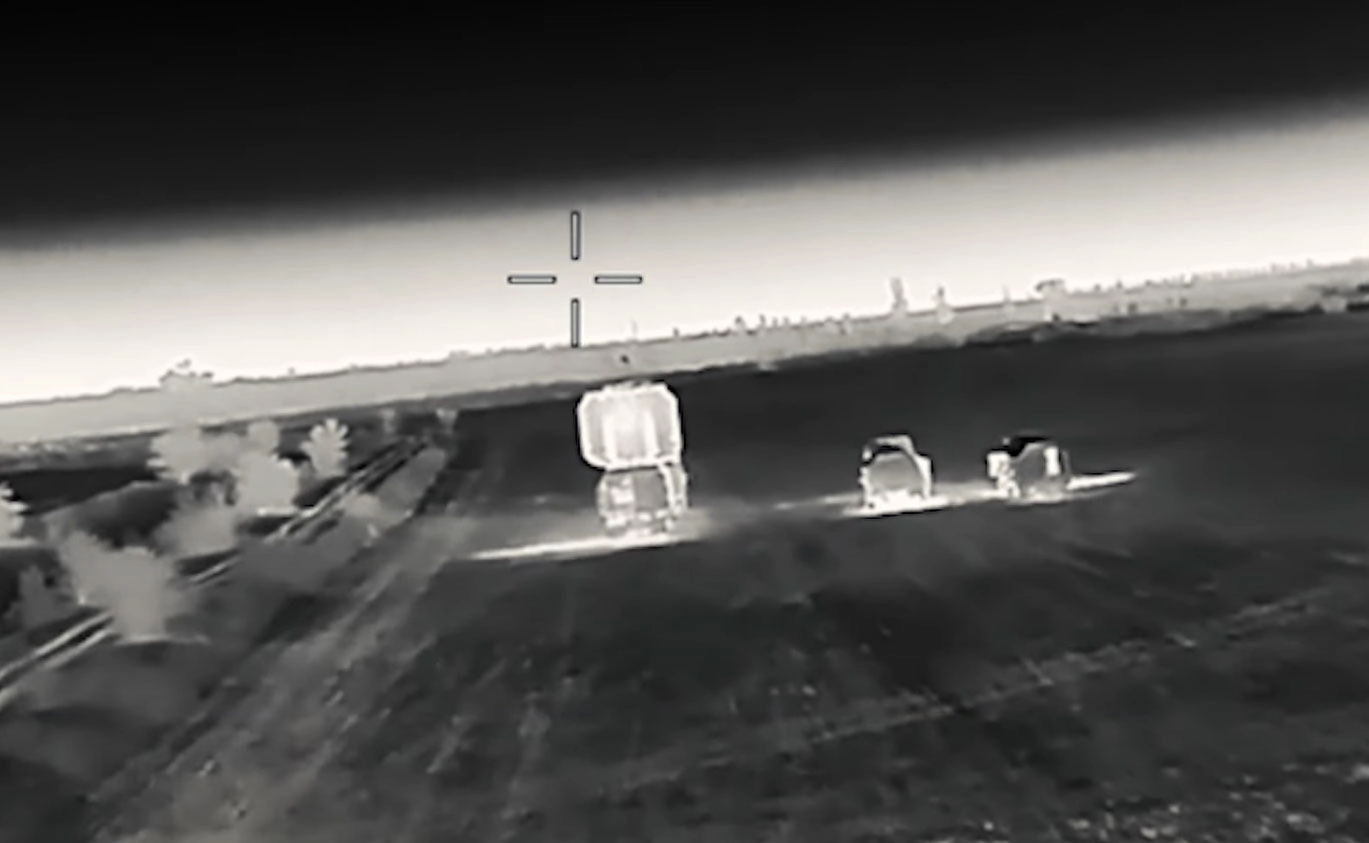
Russia’s military supply chain in southern Ukraine is coming under increasing pressure from Ukrainian drone attacks. The P-280/M-18 highway, which connects Rostov-on-Don with Mariupol, Melitopol and occupied Crimea, has now acquired a new name: “The Road of Death.”
For Moscow, this route is a vital supply artery. It is the main land corridor connecting Russia with Crimea, bypassing the Kerch Bridge, which remains vulnerable to Ukrainian attacks.

Since late May, civilian traffic along much of the route has been virtually halted. Videos are increasingly circulating on social media showing damaged military trucks along the road, as well as moments of Ukrainian drone attacks.
Last week, traffic on the Tsonhar Bridge, one of the most important connecting points between the occupied region of Kherson and Crimea, was temporarily suspended following Ukrainian attacks.

Strikes quadrupled
Ukrainian President Volodymyr Zelensky recently said that such attacks have increased dramatically. “Today, there are twice as many strikes at distances of more than 20 kilometers compared to March and four times more than in February. And their number will continue to grow,” he said. A few weeks later, Ukraine’s Deputy Prime Minister and Minister of Digital Transformation, Mykhailo Fedorov, said that the strategic goal is to create a complete “accounting siege” of Russian forces.
Among the systems reportedly being used are Hornet-type drones, equipped with artificial intelligence to detect vehicles. These can operate at distances of up to 150 kilometers and patrol almost constantly over supply lines.
At the same time, information speaks of the use of the new Ukrainian drone of the “Morrigan” type, about two meters long.
According to the commander of the Unmanned Systems Forces of Ukraine, Robert Brovdy, military traffic on the R-280 route has decreased by 71% in just two weeks. While along the main roads more and more burnt military vehicles appear, and Russian columns are forced to use secondary routes to avoid detection.


