
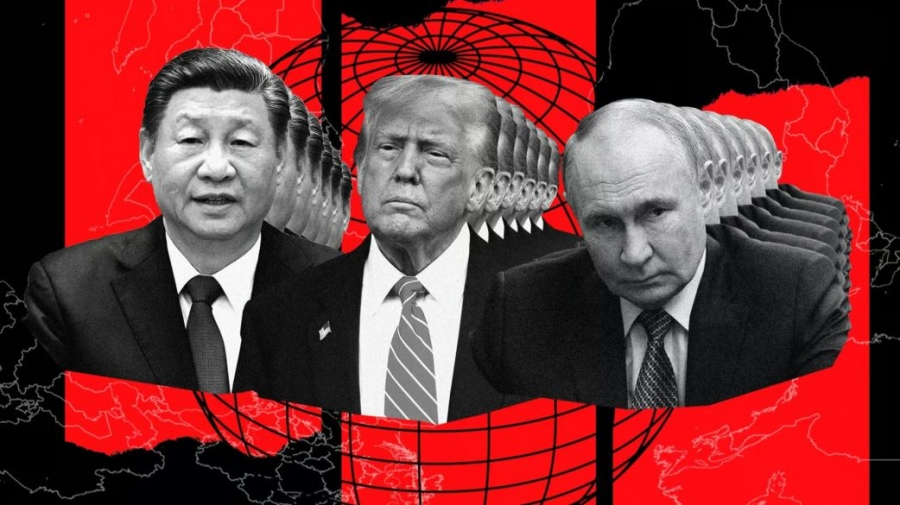

In an increasingly unstable international environment, geopolitical balances seem to be hanging by a thread.
Donald Trump’s moves towards Russia, China and Iran are bringing back to the fore scenarios of intense global confrontation, with Vladimir Putin at the center of a broader effort at political and diplomatic isolation.
At the same time, Washington is attempting to exert pressure on Beijing, using the Taiwan issue as a key bargaining chip, while developments in the Middle East and the possibility of military escalation against Iran threaten to trigger a new crisis with global consequences.
Amid this explosive backdrop, contacts between the US and China are taking on critical importance, as their outcome may determine not only the course of US-China relations, but also the broader stability of the international system.
Official visit
Donald Trump is expected to arrive in Beijing on May 14–15 for an official visit and talks with Chinese President Xi Jinping. This is the first visit by a sitting US president to China since 2017. His predecessor, Joe Biden, had not visited the country.
It is clear that the timing of the visit is not coincidental. Trump seems to be trying to catch up with Russian President Vladimir Putin, who is also planning an official visit to China soon. On May 11, Russian Ambassador to China Igor Morgulov and Chinese Vice Foreign Minister Liu Bin discussed the documents to be signed during the Russia-China summit.
Trump’s visit to Beijing was accompanied by another event that went almost unnoticed: an American strategic nuclear submarine of the Ohio class, equipped with intercontinental ballistic missiles, visited a NATO base in Gibraltar. This submarine can carry up to 20 Trident II D5 ballistic missiles with multiple, independently guided nuclear warheads.
American Trident missiles can easily hit Iran. But why such a show of force just before Trump’s visit to China? And how could this meeting affect the global balance of power?
It is difficult to believe that issues such as China’s relations with Russia and its support for Iran will not be raised. What prompted Donald Trump and Xi Jinping to meet at this very moment?
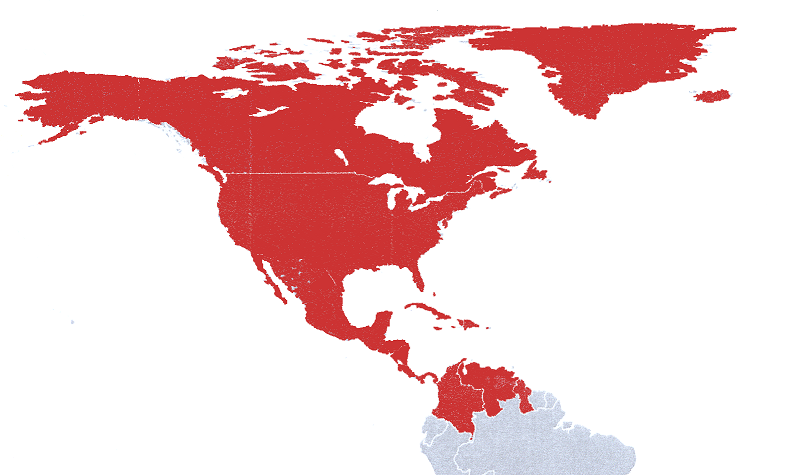
It is obvious that, under the weight of recent developments, Trump is now looking for international support. Washington’s relations with Japan and South Korea have deteriorated, the US is essentially in a kind of Cold War with Europe, while there are also tensions with Canada. Trump has ended up largely isolated on the international stage.
In these circumstances, he seeks to present himself as a world leader who can “solve problems” in consultation with another superpower, China. Especially since the Asia-Pacific region is currently the most sensitive front for the United States.
Taiwan as a bargaining chip
The idea that Taiwan could be used as a bargaining chip by the US is currently being strongly promoted. It is no secret that Washington supplies Taiwan with weapons. Last December, the US approved arms packages worth $11 billion, and in March another $14 billion.
So Taiwan is not just a point of contention between the US and China. It is also a major market for the US defence industry. And now the US may offer to reduce its support for Taiwan in exchange for other concessions. Exactly what these will be remains to be seen.
As for the means of pressure that Trump could apply to China, beyond tariffs, which the US Supreme Court ruled unconstitutional, “the Americans, as recent developments have shown, are not particularly capable negotiators. Their main tools remain pressure and threats.
Now that the Ohio-class nuclear submarine is in Gibraltar, Trump may either consider a strike against Iran or use this threat as leverage to pressure China, demanding that it limit its support for Tehran, one of Beijing’s key strategic partners.
There is also the possibility that Trump may ask China to review certain aspects of the bilateral trade and economic relationship. For example, increasing Chinese imports of American products.
Russia-China relations
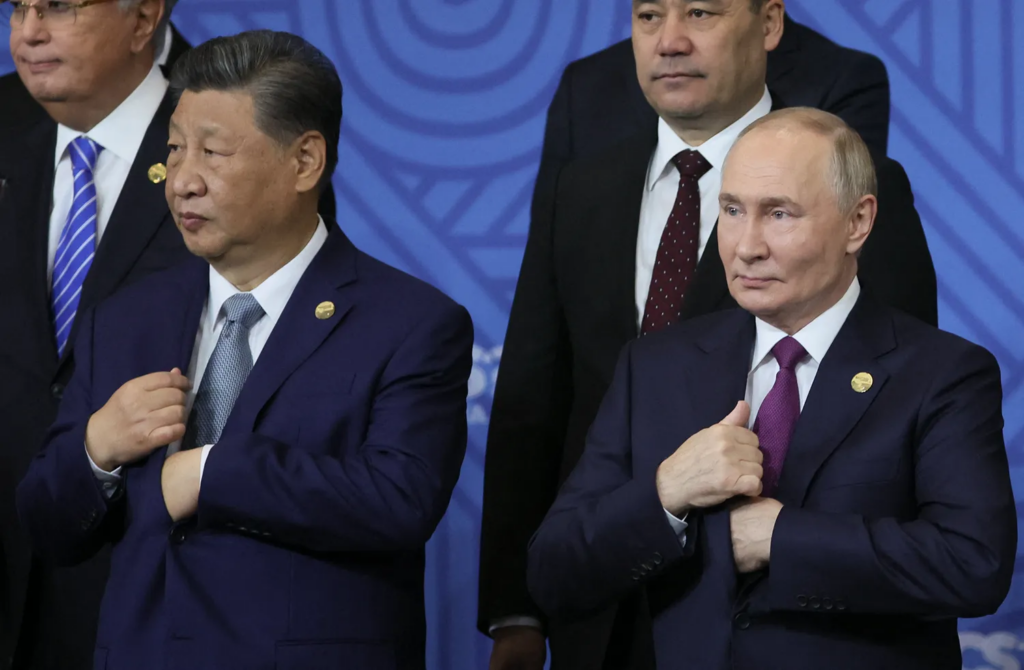
In terms of Russia-China relations, Trump will likely ask Xi Jinping to personally influence Vladimir Putin to end the conflict between Russia and Ukraine.
He may even make it a demand, offering to reduce US aid to Taiwan in return. If the Ohio-class nuclear submarine launches a strike against Iran before or during the talks, Trump may take an even tougher stance on Chinese support for Iran.
Such a development would be a blow to Xi’s prestige. As for trade between Russia and China, it is unlikely that Trump will be able to change anything substantially: the two countries share an extensive land border and can move hydrocarbons and other goods overland.
In theory, Trump could create some problems by putting pressure on Chinese banks that handle Russian payments, but this would be of limited importance.
Moreover, with Vladimir Putin’s upcoming visit to Beijing, Xi Jinping would hardly be willing to seriously discuss limiting economic cooperation between Russia and China. For its part, China expects Trump’s visit to have long-term consequences, especially given the unpredictable stance of the US President.
During his previous visit to China, in 2017, the two sides agreed to develop trade and economic relations. However, less than a year later, in 2018, Trump launched a trade war against Beijing.
China is a member of the SCO and the BRICS. In a period of international tension, hosting an ally’s main rival raises reasonable questions. Diplomats speak of a “massive package” of issues to be negotiated. What could this package include?
The classic American package of demands: limiting military aid to Iran, trying to “balance” relations with Russia, and influencing Moscow’s stance on the conflict in Ukraine. Trump can push as hard as he wants on trade and economic relations with Russia. After another similar American “pressure,” Xi Jinping visited Moscow in March 2023.
At the end of that meeting, the Chinese leader declared: “The world is changing, and we are managing these changes together.” Our countries are too closely intertwined for any significant pressure to be exerted on bilateral Russian-Chinese relations.

