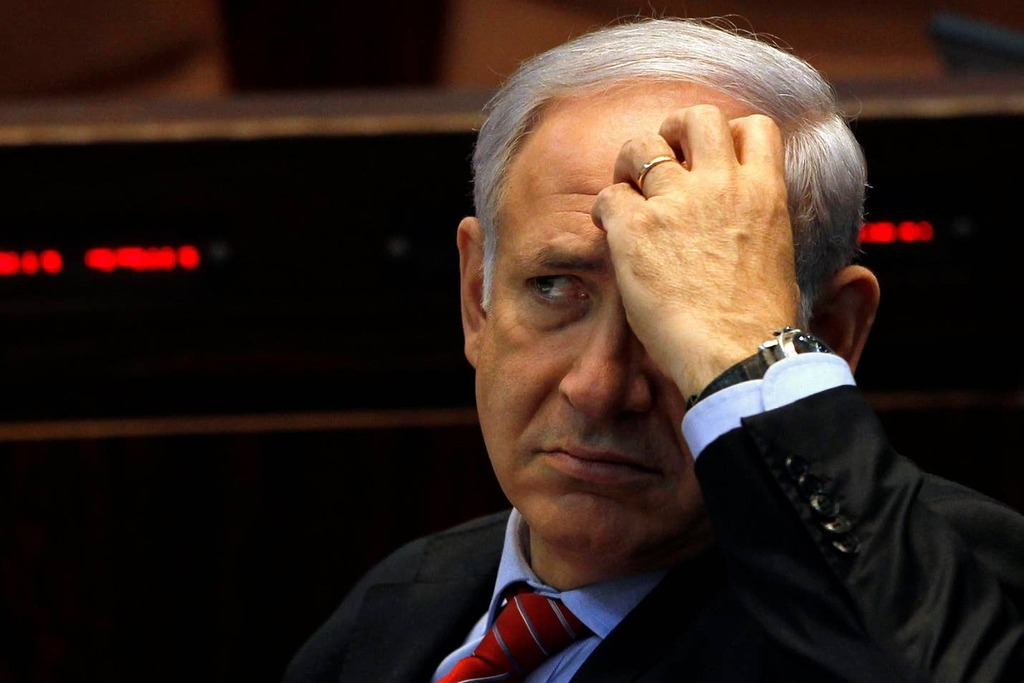
Benjamin Netanyahu, the leader of Israel, seems to be navigating the turbulent waters of a war for which his military is unprepared. With its missile and air defense systems depleted, and Tehran playing its cards masterfully, his country faces an unprecedented danger.
Every strategic decision now has a global dimension: is it the end of Israel or the end of the world?
The angry Mayor of Tel Aviv
A video that recently went viral shows Tel Aviv Mayor Ron Hulday angrily asking Israeli Prime Minister Benjamin Netanyahu: “We are devastated! We have been living in shelters for weeks! Why are we suffering?”… The mayor almost slammed his fist on the table.
It was March 27. In those days, Tel Aviv was receiving waves of Iranian ballistic missiles and long-range drones. The air defenses were collapsing. Dozens of cluster bombs were dropped on the city. Few things were working. Netanyahu, apparently, had no time for the mayor’s concerns.
That same day, he was informed of the massive ambush that Hezbollah had set on Merkava tanks in Lebanon—the pride of the Israel Defense Forces. Despite strict censorship, it became known that the previous day Hezbollah had destroyed an armored column in southern Lebanon. First they hit the first tank with an anti-tank drone, then the one at the rear, and then methodically hit the rest. Trapped in the mountains, the column had no way out. The surviving crews tried to escape to the foothills, but were met with machine gun fire. In the end, eight Merkava tanks and many other vehicles were destroyed in a single battle. (for more information about the issue please read the analysis titled “Major Israeli Defeat with Merkava Battle Tanks in Hezbollah Ambushes in Lebanon“).
Against the backdrop of Israel’s failed ground operation in Lebanon, Netanyahu announced that he would call up 400,000 reservists, causing embarrassment to military analysts. And the question is “He just called up 300,000, of whom 30% did not show up. Where will Netanyahu find 400,000?” . For now, the answer remains unknown in Tel Aviv. Like many others…
A month after the start of the war with Iran, at least two myths have begun to disintegrate: that the IDF is invincible and the resilience of the Iron Dome. Moreover, in a war waged on land, sea and air, the Israeli air defense system, under constant attack, is proving to be a greater threat to the country than Hezbollah’s ambushes.
Iran’s ballistic missiles are already hitting the sanctities of the Jewish state, including the secret nuclear center near the cities of Dimona and Arad (with more than 100 injured in a recent attack). Air raid sirens are blaring incessantly in the area, but it seems that the Persians are not yet targeting the nuclear center itself.
Protracted War
Netanyahu clearly did not prepare for a protracted war, believing that Iran would capitulate within a week at most. Apparently, the intelligence services relied solely on the results of last summer’s twelve-day campaign.
Today, however, it is becoming clear that Tehran did not reveal all its cards during the exchange of attacks in June, convincing its opponent of its weakness. The rapid depletion of anti-missile and interceptor stocks is forcing Israeli generals, a month after the start of the war, to prioritize the most critical facilities.
At the top of this list, of course, is the nuclear center. No matter how much the mayor of Tel Aviv complains, this does not change anything — the city of half a million inhabitants continues to receive arrivals at an increasing rate.
Iran did something that no one expected: in the first days of the exchange of attacks, it neutralized radars and sensors at American military bases in Bahrain, Qatar and the United Arab Emirates. These radars, worth 1.5 billion dollars, were part of a unified air defense network used by the United States, Israel and the Persian Gulf states, providing warning of missile launches. This gave time to prepare for the attack and intercept it.
Until recently, Israel’s multi-layered air defense system was considered almost impenetrable.
- The first layer, known as Iron Dome, protects Israeli cities and infrastructure from short-range missiles, such as those fired by Hezbollah and Hamas.
- To defend against cruise missiles and medium- and long-range ballistic missiles, which pose the greatest threat in the current war, Israel has three additional layers: David’s Sling, the Arrow 2 and Arrow 3 systems, and the Terminal High Altitude Area Defense (THAAD) system provided by the US.
- The US Air Force and Navy, which are stationed in the region, also provide support.
All of these were operational last summer, but have been out of action since March. Without American radar, the air defense system was “blinded,” and Iranian retaliation, despite losing several missile launchers in the first week of the war, began to hit its targets with increasing frequency.
Since February 28, Iranian drones have struck at least ten U.S. radar sites in the Middle East. These include several AN/TPY-2 radars used in the THAAD system and an AN/FPS-132 phased array antenna in Qatar.
The loss of one radar does not disable the entire air defense system, but the loss of ten radars or detection systems significantly reduces the ability to identify and respond to incoming threats. The problem has been exacerbated by a lack of anti-missile weapons.
Iran has overwhelmed Israeli air defenses with drone attacks and cluster munitions, forcing the Israeli military to deploy interceptors in huge numbers.
Losses
In the first three weeks, the Israeli Army spent up to 80% of its most advanced anti-aircraft ammunition.
It is worth noting that during the 12-day war, Iran used almost the same drones and missiles, but they caused much less damage.
Apparently, Tehran surpassed both the Mossad and the CIA in terms of information about its military potential. Israel can build similar air defense systems and ammunition, but this will not significantly change the situation. Especially since the Americans, responsible for overseeing Israeli airspace, suffer further and significant losses.
Among the recent losses was a Boeing E-3 Sentry early warning and control system (AWACS) aircraft, which was shot down by the IRGC at Prince Sultan Air Base in Saudi Arabia. This is the first loss of this type of aircraft, worth about $ 500 million, in the history of its operational activity.
In this context, even the destruction of a US Air Force tanker at the airport seems like a small, albeit unfortunate, loss. The E-3 Sentry acts as a “flying command center” and airspace control system.
In theory, the Americans should have given priority to protecting the AWACS aircraft, but the air defense system again failed to protect them.
The operation is going disastrously for the US and Israel, the Strait of Hormuz remains closed, oil prices show no signs of abating, and the world is on the brink of a global economic crisis comparable to the 1973 energy crisis.
Trump and Netanyahu see a ground operation as the solution. Meanwhile, the Israeli prime minister has announced that the Israel Defense Forces would not be able to contribute, as they are fighting Hezbollah.
This means that US marines and paratroopers will have to carry out “heavy assaults” on the islands in the Persian Gulf or seize beachheads in the Iranian hinterland. The result, for most analysts and military experts, is obvious: hundreds, if not thousands, of coffins will return to America, and the demonstration of success will be limited to a “flag waving.”
Iran has already warned that, in the event of an invasion, it will wipe out the entire Arab oil industry, along with its desalination plants, returning the Arabian Peninsula to the early 20th century.
Iran has a specific list of targets in the region. Such as a refinery in Saudi Arabia that processes 12 million barrels of oil per day.
There is no doubt that a hard blow will follow in retaliation against Israel, including its nuclear center in the Negev desert.
Netanyahu is very aware of the state of its air defenses. Enormous damage would immediately transform the use of nuclear weapons from a theoretical to a practical issue (for more analysis on the subject please read the article titled “Will Israel use nukes?“).
Netanyahu has the button
Both Trump and Netanyahu have already discussed this option. A US Trident ballistic missile submarine is in the North Arabian Sea, and Netanyahu already has the “button” in his hands…
Trump, of course, has stated that he will never start a nuclear war, but he has said many other things. As for Netanyahu, if the time comes, he will not hesitate.
The most frightening thing is that no one knows for sure whether Iran has a nuclear bomb or not. What have they managed to create in their secret laboratories? Iranian physicists are extremely capable, and their engineers, judging by their drones and missiles, seem to be very capable as well.
Trump still has a chance to avoid getting embroiled in a story where his name will be linked to the bloodiest names of war criminals – to declare victory and withdraw from the Persian Gulf.