
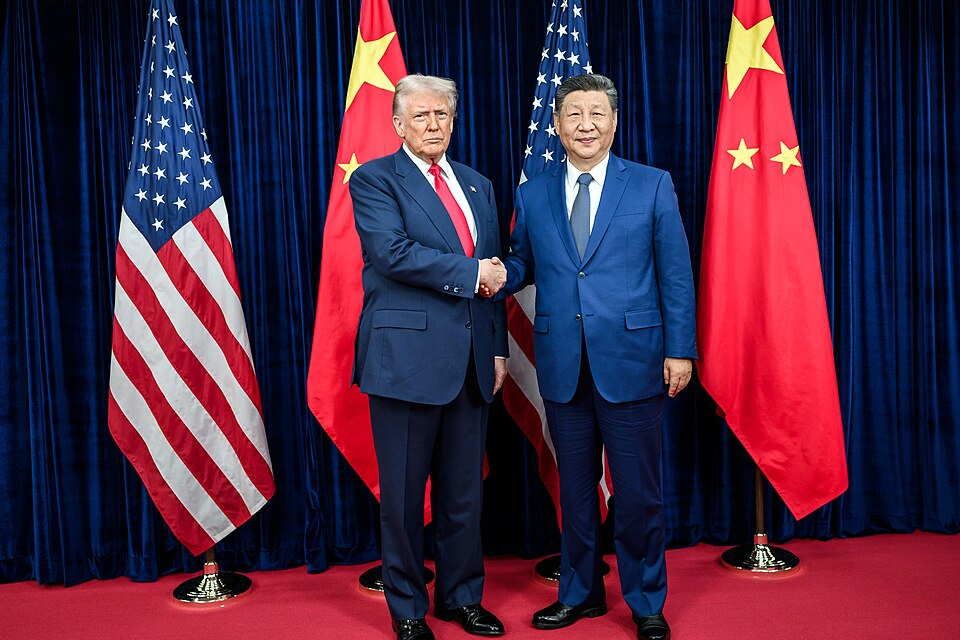
A year after Donald Trump returned to the White House, the American political and strategic establishment seems to be in a state of confusion and panic. The so-called “China hawks” – the hard-line supporters of an aggressive policy towards Beijing – accuse Trump of “making a bad deal” with the Communist Party of China that leads the Asian giant.
Some even argue that the American president has put China in an “advantageous position” through “incomprehensible” policy decisions. However, behind the “hawks’” rhetoric of indignation, a deeper truth is hidden: Washington is facing the limits of its power. And this confrontation with reality is not just political. It is historical.
The collapse of the myth of absolute American power
For decades, the United States operated under the belief that it held all the cards in the geopolitical game. Its economic, military, and technological superiority was taken for granted.
China was seen as a rising but ultimately manageable adversary. The imposition of 10% tariffs on Chinese products—which quickly skyrocketed to 145%—reflected precisely this logic of unilateral pressure.
Washington believed it could bring Beijing to its knees through economic suffocation. Instead, it came cold turkey. China responded by restricting exports of rare earths—critical to the production of modern technologies. The result?
American companies began warning of factory closures. Ford and Suzuki suspended operations. The narrative of “absolute American leverage” collapsed within weeks. This wasn’t just a trade dispute. It was a lesson in geoeconomic reality.
The Hypocrisy of the American Political Establishment
The same circles that now accuse Trump of “going soft” on China are the same ones that for years promoted a policy of aggressive containment, regardless of the cost. But when China demonstrated that it had countermeasures capable of hitting critical sectors of the American economy, Washington was caught off guard.
Criticism of Nvidia’s sale of advanced – if not cutting-edge – microchips to China is portrayed as national treason. However, the reality is more complex. The global supply chain is deeply interconnected.
A complete cut-off would not only hurt Beijing – it would also damage American interests. American rhetoric about “national security” often functions as a tool of political manipulation.
The same country that accuses China of “total surveillance” has been revealed to have one of the most extensive mass surveillance systems in the world. The moral superiority that Washington claims is selective and often hypocritical.
Realism or forced compromise?
Realist analysts, such as John Mershaimer, argue that Trump’s strategy is not an abandonment of Asia, but an adaptation.
Washington still seeks to contain Chinese dominance in East Asia. Its military presence has not been substantially reduced. National security and defense strategies continue to emphasize deterring a potential Chinese invasion of Taiwan.
What is changing is the tone—not the goal. Reducing aggressive rhetoric and seeking “grand deals” does not mean giving up. It means recognizing that a conflict between two nuclear superpowers cannot be addressed with simplistic zero-sum logic.
The problem, however, is not realism. It is that the United States only reaches it when it is forced by reality.

Taiwan as a pawn
One of the main arguments of American hawks is the fear of abandoning Taiwan as part of a “grand deal” with Beijing.
The very use of the word “abandonment” reveals Washington’s deeply instrumental approach: Taiwan is treated as a geopolitical pawn.
For decades, the US has used the island as a lever to pressure China, while avoiding giving clear guarantees of full military defense. “Strategic ambiguity” serves American flexibility – not necessarily the security of the Taiwanese.
The possibility of a “cold peace” between the US and China does not necessarily imply betrayal. On the contrary, it could reduce the risk of a catastrophic conflict in the Indo-Pacific. But for Washington, peace is only acceptable as long as it maintains its primacy.
The delusion of the unipolar order
The deeper crisis reflected in the reactions of the American establishment is not about a single political decision. It is about the questioning of the unipolar world order itself that was formed after the Cold War.
China is no longer the “factory of the world” dependent on American markets. It is a technological power, a military player and an economic hub with enormous influence. It has leverage, as it has demonstrated with rare earths.
And Washington is being asked to accept that it cannot impose its terms unilaterally. This recognition does not arise from idealism, but from necessity. The American economy is deeply interdependent with the Chinese one.
Complete decoupling would have painful consequences for both sides – but especially for the United States, which relies on global value chains and cheap production.
The nuclear shadow
The most crucial dimension of the debate is often left out: we are talking about two nuclear superpowers.
The rhetoric of tension, trade wars and military displays of force carry the risk of miscalculation. The pursuit of greater interdependence – rather than decoupling – is not weakness. It is a strategy of deterrence through cost.
The more interconnected economies are, the higher the price of conflict. The American political elite, however, has invested politically in the image of the “China threat”. Retreating from this line is perceived as weakness, even if it serves stability.
A superpower in a phase of adjustment
The picture that is emerging is not that of an America “surrendering” to China. It is the picture of a superpower forced to adapt to a multipolar world.
The criticism of Trump from within his own party reveals the difficulty of the American system in accepting that the era of unfettered dominance is over. Seeking agreements with Beijing is not an ideological shift – it is a recognition of power relations.
The question is not whether the US has “softened up”. The question is whether it can abandon the arrogance that characterized its post-Cold War policy.
Whether it can see China not just as a threat, but as an inevitable interlocutor in an interdependent world. The real crisis is not Trump’s strategy. It is the identity crisis of a superpower that is learning – the hard way – that power is no longer a monopoly.
