


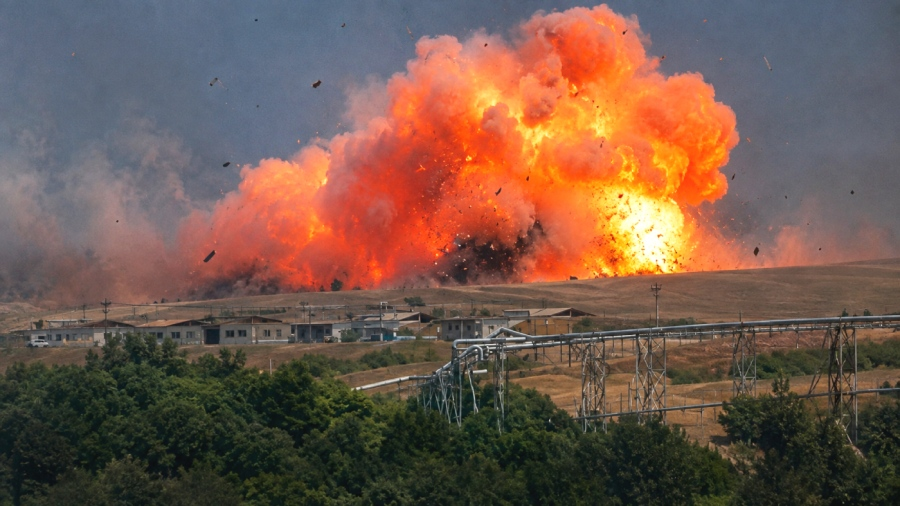

Refineries and pumping stations for “black gold”, petrochemical plants, oil terminals, natural gas infrastructure and electrical substations: Ukrainian drone attacks inside Russia, targeting its energy sector and by extension the “fuel” for its “war machine”, have recently evolved into a strategically coordinated campaign.
Some have been carried out as deep as 1,400 kilometers inside Russian territory.
Although their scale is much smaller than that of the Russian strikes on Ukraine’s energy infrastructure – which have decimated around 70% of the war-torn country’s electricity generation capacity – the consequences are starting to be visible and felt on the side of the aggressor.
Ukrainian drone attacks on the Russian energy sector had already caused at least 60 billion rubles in damage by March 2025.
16 of Russia’s 38 refineries have been hit by Ukrainian drones, some more than once, including one of Russia’s largest fuel processing plants in Ryazan, near Moscow.
The strikes have reduced Russia’s refining capacity by 17% to 1.1 million barrels per day, sending wholesale fuel prices soaring.
If Ukrainian forces continue their attacks at this rate, Russian diesel exports will fall to their lowest level since 2020.
And that is exactly what they will do, Ukrainian President Zelensky told Axios, stressing that he has the support of US President Trump.
A spiraling Russian fuel crisis
At least four major oil refineries have been shut down after Ukrainian attacks, the Moscow Times reports, affecting 13% of Russia’s total refining capacity.
In a sign of a supply crisis, some 360 gas stations have closed in the past three months alone, according to Kommersant, mostly in the south and independently.
They are not part of large oil company chains, which means they face greater difficulties in fuel supplies, due to reduced production and high lending rates: the Russian Central Bank’s “brake” on inflation and the risk of recession.
By mid-September, shortages of popular grades of gasoline were reported in 21 Russian regions.
Now gas stations across Russia have begun to limit sales, according to the pro-government newspaper Izvestia.
In central Russia, the Volga region, the south and the Far East, there is now a cap of 10-20 liters of gasoline per purchase or only diesel is available, says Pavel Bazhenov, president of the Independent Fuel Union (NTS).
This, while there was already a ban on gasoline exports
As announced by Russian Deputy Prime Minister Alexander Novak, the ban will be extended until the end of the year, now even putting in the same “equation” the imposition of a partial ban on diesel exports.
Gasoline prices have meanwhile increased by 40-50% since the beginning of the year, prompting the Russian government to order oil companies to activate reserve capacity, delay scheduled maintenance and coordinate rail fuel transport.
And so, the war in Ukraine is being transferred to Russia’s streets and households, while reducing state revenues.

“Mobile sanctions”
Despite the numerous sanctions, Russia’s energy industry and exports have so far cushioned the economic fallout, largely financing the war in Ukraine.
But Kiev now calls drone attacks on Russian energy infrastructure “mobile sanctions.”
They hit the Kremlin in its “Achilles heel”: oil and gas revenues.
They have accounted for between a third and a half of Russia’s federal budget over the past decade and have been the main source of “fuel” for its war machine for about 43 months.
Since the start of the full-scale invasion of Ukraine in February 2022, the Russian government has increased its spending by 75%.
But in the first seven months of the year, the budget deficit reached 4.88 trillion rubles.
That is three times higher than the previous year and represents about 2% of GDP.
Russia now plans to raise VAT to cover increased government spending.
The Finance Ministry on Wednesday proposed raising the country’s value-added tax (VAT) from 20% to 22% from next year, calling the measure necessary “primarily to finance defense and security.”
Tightening the noose
A combination of developments suggests that the intensification of Ukrainian attacks on Russia’s energy infrastructure may be part of a broader strategy to end the war in Ukraine, the risk of which has escalated in recent days.
Amid mounting pressure from the US, the European Commission has proposed, among other things, in its 19th sanctions package to accelerate the ban on imports of Russian liquefied natural gas (LNG) to 1 January 2027.
Separately, it is now considering imposing tariffs on Russian oil, making imports that Hungary and Slovakia continue to resist more expensive.
Having already asked NATO member states to completely stop buying Russian oil, as a condition for the US to impose tougher sanctions on Moscow, Donald Trump called on Turkish President Recep Tayyip Erdogan to cut energy ties with Russia in a trade-off.
“The best thing he could do is not buy oil and gas from Russia,” he said in their heated meeting on Thursday at the White House, which Trump described as “extremely decisive.”
Speaking at the 80th UN General Assembly, the US president had already targeted India and China as “the main financiers of the war [in Ukraine], continuing to buy Russian oil.”
They are getting it cheap, however, less than a month after Chinese President Xi and Indian Prime Minister Modi joined hands with Russian President Putin at the Shanghai Cooperation Organization (SCO) summit.
Trump’s gamble
That said, it remains to be seen if, when, and how much what the US president now considers the “recipe” for ending the war in Ukraine will pay off.
Reducing Moscow’s revenues from fossil fuel exports, provoking internal discontent in Russia, and forcing the Kremlin into peace talks, this time in a less advantageous position.
For Trump—a narcissistic MAGA revisionist who believes only in the “law of the strong” but covets the Nobel Peace Prize—this is a multiple gamble.
He is sorry for his leadership profile, which has been “scratched” after the summit with the unconvinced Putin in Alaska and the ongoing war in Gaza, while he is preparing to meet with his biggest rival, Chinese President Xi, at the end of October.
On the other hand, for the US economy, which, contrary to what he claims, is not living a “golden age” and finding a new “customer” for American LNG exports would be the right thing to do.
The same applies to the sales of American weapons to Ukraine through NATO, with the money of the Europeans.
