

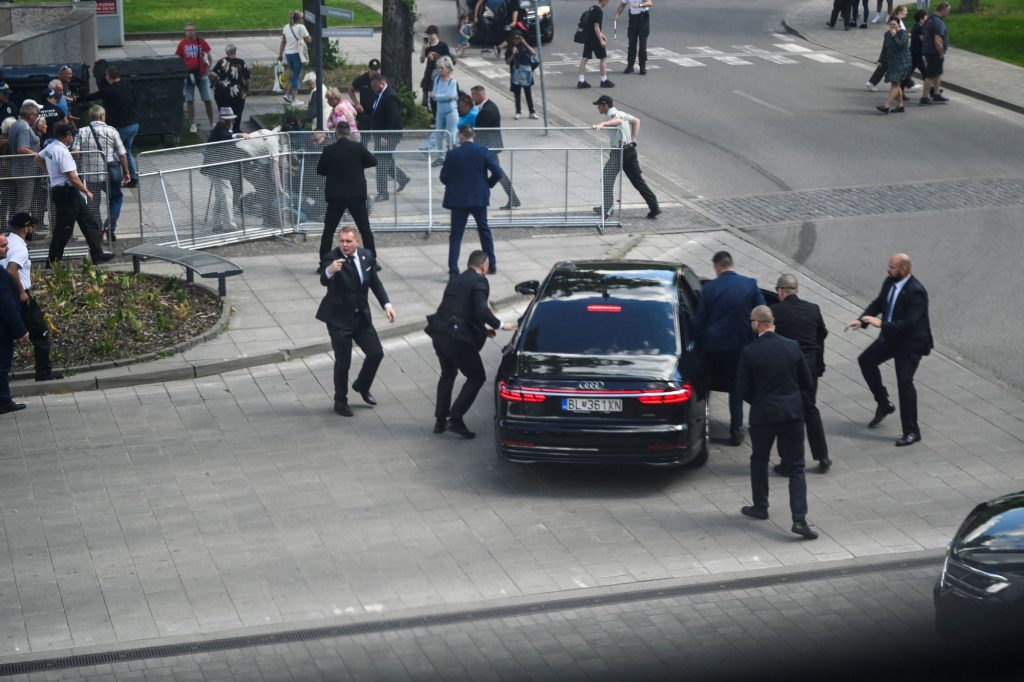
An assassination attempt against the elected prime minister of Slovakia took place at noon on Wednesday (15/05) just outside Bratislava, shocking Europe and the whole planet. On the official page of the prime minister of Slovakia, it is stated that he received “several bullets” while leaving a building after a government meeting. The prime minister’s office emphasized that Robert Fitso was taken by helicopter to the Banska Bystrica hospital and is fighting to stay alive.
The perpetrator of the attack is a 71-year-old Slovak writer named Juraj Cintula who pretended to greet him and opened fire on him. After the assassination attempt, the perpetrator was arrested.
Shocked by the heinous attack against the prime minister of Slovakia, the whole of Europe is watching with its leaders condemning it.
Veteran of politics
In October 2023, Robert Fičo was re-sworn as the prime minister of Slovakia and appointed head of a coalition government. The grizzled and brash political veteran served three terms as prime minister carrying the “label” of the pro-Russian and anti-European politician. He started as a communist, switched to social democracy and evolved into a populist, even allying with the far right to form a government.
Head of the Slovak government from 2006 to 2010, from 2012 to 2018, from 2023 to the present when an unknown person tried to assassinate him, he led his country to the Schengen Zone in 2007 and the Eurozone in 2009.
He made a triumphant return to power last year when his party, SMER-SSD, won with 23.37% of the vote, followed by the liberal Progressive Slovakia (PS) and the HLAS (Voice) party.
He “rode” the bandwagon of the new wave of nationalist-populist politicians that emerged in the last decade, taking advantage of the wave of discontent created among tens of millions of Europeans.
After the murder of investigative journalist Jan Kuciak and his fiancee Martina Kusnirova in 2018, the investigation revealed large networks of corruption involving high-ranking government officials, leading to Fico’s resignation under pressure from mass protests.
His first steps in life and politics
In his early life he grew up in Topoľčany, a small town in western Slovakia. He was the son of a forklift driver and a shop worker.
He attended local primary and secondary schools and then enrolled to study law at Comenius University in the capital Bratislava. In 1987, the then 23-year-old Fitso joined the Communist Party, believing that it would be a useful step for his advancement.
As a young man, Fico remained largely within the system, serving his military service as a researcher, earning a doctorate studying the death penalty, and then working in the legal department of the Slovak Academy of Sciences. This was not the path of a radical, a political demagogue, or an angry or frustrated man determined to change his world for the better.
Then an era was ending. In 1989, the Berlin Wall fell and the “Velvet Revolution” ended communist rule in Czechoslovakia. Slovakia gained independence in 1993, by which time a fragile social democracy had been installed in place of totalitarian rule.
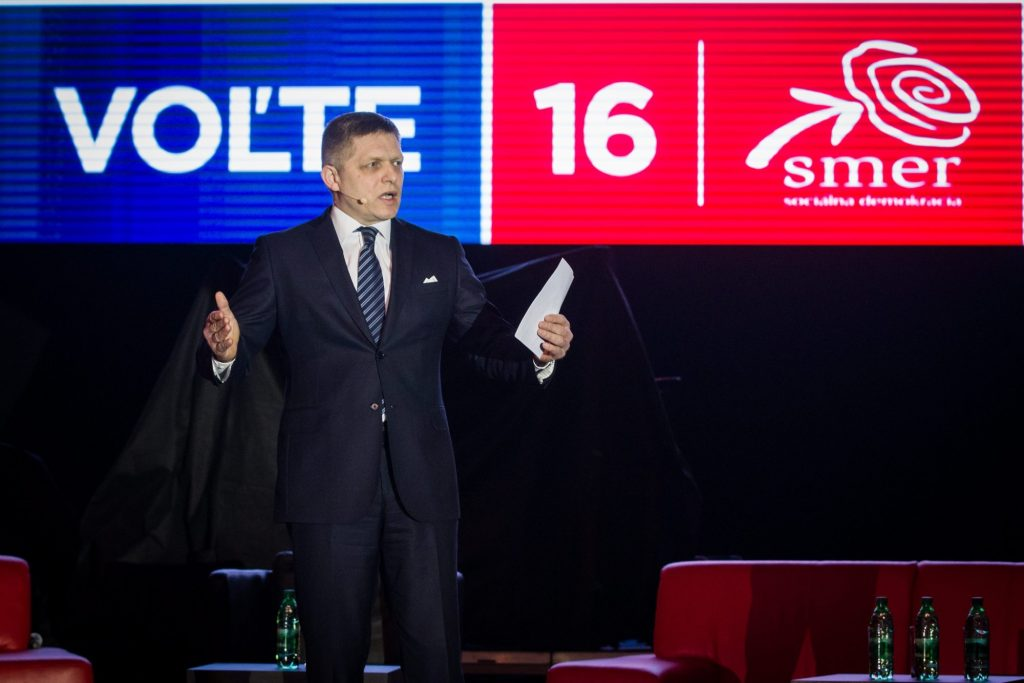
The new free capitalist era offered opportunities to entrepreneurs and political entrepreneurs. Fitzo was young, persuasive and, above all, untainted by any connection to the communist regime. His new career as a politician – a childhood ambition – progressed quickly.
He first joined the Party of the Democratic Left and then founded Smer – sociálna democracia (Direction – Social Democracy, Smer-SD). The new organization extolled both democracy and socialism, although many observers quickly concluded that ideology took second place to its leader’s own ambitions.
After seven years in the opposition seats, he won the first electoral contest in the 2006 elections.
Fitzo’s party won power again in 2012 after a centre-right coalition collapsed. His tough stance on immigrants won him re-election in 2016.
The murder of investigative journalist Jan Kuciak and his fiancee Martina Kusnirova in 2018 brought huge protests in the country at the time as large corruption networks implicated high-ranking government officials.
Robert Fitzo resigned and the political formation he led (SMER) lost power in the 2020 elections to parties pledging to eradicate corruption.
His return and the “no” in Kiev
However, he did not give up and three years later he returned to power. Russia’s invasion of Ukraine exposed his pro-Russian sentiments with verbal attacks on its Western allies, pledges to end military support to Kiev, criticism of Russian sanctions and threats to veto any future NATO invitation to Ukraine .
Fico, who analysts say is inspired by Hungary’s Viktor Orbán, has said he has Slovakia’s interests in mind.
“We see Viktor Orbán as one of those European politicians who is not afraid to openly defend the interests of Hungary and the Hungarian people,” he told Reuters. “He puts things first. And that should be the role of an elected politician, to look after the interests of his constituents and his country,” he added.


